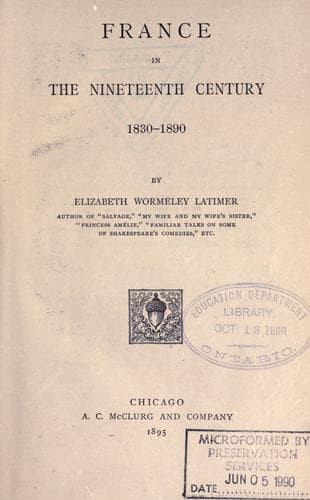
France in the Nineteenth CenturyLatimer, Elizabeth Wormeley
History
France in the Nineteenth Century
Latimer, Elizabeth Wormeley
France -- History -- 1789-1900
On the night of January 6, the commandant of the fortress, in full
uniform, accompanied by a Government agent, entered the sleeping-room
of each prisoner, and ordered him to rise and dress, as he was
to be sent immediately into exile under charge of two agents of
police detailed to accompany him over the frontier. Nor was he
to travel under his own name, a travelling _alias_ having been
provided for him. At the railroad station at Creil, Colonel Charras
met Changarnier. "_Tiens, Général!_" he cried, "is that you? I am
travelling under the name of Vincent." "And I," replied Changarnier,
"am called Leblanc." Each was placed with his two police agents
in a separate carriage. The latter were armed. Their orders were
to treat their prisoners with respect, but in case of necessity
to shoot them.
The journey was made without incident until they reached Valenciennes,
a place very near the frontier line between France and Belgium.
There, as the _coup d'état_ had proved a success, official zeal
was in the ascendency. The police commissioner of Valenciennes
examined the passports. As he was taking Leblanc's into his hand,
he recognized the man before him. He started, and cried out: "You
are General Changarnier!" "That is no affair of mine at present,"
said the general. At once the police agents interposed, and assured
the commissioner that the passports were all in order. Nothing
they could say would convince him of the fact. The prefect and
town authorities, proud of their own sagacity in capturing State
prisoners who were endeavoring to escape from France, held them
in custody while they sent word of their exploit to Paris. They at
once received orders to put all the party on the train for Belgium.
Charras was liberated at Brussels, Changarnier at Mons, Lamoricière
was carried to Cologne, M. Baze to Aix-la-Chapelle. They were not
released at the same place nor at the same time, Louis Napoleon
having said that safety required that a space should be put between
the generals.
[Illustration: _EUGÉNIE._]
CHAPTER IX.
THE EMPEROR'S MARRIAGE.
A plébiscite--Louis Napoleon's political panacea--was ordered Dec.
20, 1851, two weeks after the _coup d'état_, to say if the people
of France approved or disapproved the usurpation of the prince
president. The national approval as expressed in this _plébiscite_
was overwhelming. Each peasant and artisan seemed to fancy he was
voting to revive the past glories of France, when expressing his
approval of a Prince Napoleon. The more thoughtful voters, like M.
de Montalembert, considered that the _coup d'état_ was a crushing
blow struck at Red Republicanism, Communism, the International
Society, and disorder generally.
Public-domain text, read in full here on John Shaqi.
Reviews
Reviews
No reviews yet
Be the first to share your thoughts on this work.
Elsewhere in the archive
Join the Discussion
Join the discussion
Sign in to leave a comment or review.
Sign InorCreate an account