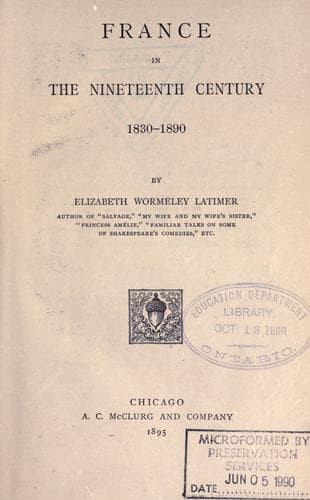
France in the Nineteenth CenturyLatimer, Elizabeth Wormeley
History
France in the Nineteenth Century
Latimer, Elizabeth Wormeley
France -- History -- 1789-1900
This circumstance, when confided to the prince president, disposed
him to be interested in the young lady. She and her mother were
often at the Élysée, at Fontainebleau, and at Compiègne. Mademoiselle
de Montijo was a superb horsewoman, and riding was the emperor's
especial personal accomplishment. On one occasion they got lost
together in the forest at Compiègne, and then society began to
make remarks upon their intimacy.
The emperor was indeed most seriously in love with Mademoiselle
de Montijo. It is said, on the authority of M. de Goncourt, that
in one of their rides he asked her, with strange frankness, if
she had ever been in love with any man. She answered with equal
frankness, "I may have had fancies, sire, but I have never forgotten
that I was Mademoiselle de Montijo."[1]
[Footnote 1: Pierre de Lano. La Cour de L'Empereur Napoléon III.]
Such a project of marriage was not approved by the emperor's family,
it was not favored by his ministers, and the ladies of his court
were all astir.
At a ball given on New Year's Day, 1853, by the emperor at the
Tuileries, the wife of a cabinet minister was rude and insulting
to Mademoiselle de Montijo. Seeing that she looked troubled, the
emperor inquired the cause; and when he knew it, he said quietly:
"To-morrow no one will dare to insult you again." There is also
a story, which seems to rest on good authority, that a few weeks
before this, at Compiègne, he had placed a crown of oak-leaves on
her head, saying: "I hope soon to replace it with a better one."[2]
Like the Empress Josephine, she had had it prophesied to her in
her girlhood that she should one day wear a crown.
[Footnote 2: Jerrold, Life of Napoleon III.]
The day after the occurrence at the ball at the Tuileries, the
Duc de Morny waited on Madame de Montijo with a letter from the
emperor, formally requesting her daughter's hand.
The ladies, after this, removed to the Élysée, which was given to
them, and preparations for the marriage went on apace.
In less than a month afterwards Eugénie de Montijo was empress of
France.
Here is the emperor's own official announcement of his intended
marriage:--
Public-domain text, read in full here on John Shaqi.
Reviews
Reviews
No reviews yet
Be the first to share your thoughts on this work.
Elsewhere in the archive
Join the Discussion
Join the discussion
Sign in to leave a comment or review.
Sign InorCreate an account