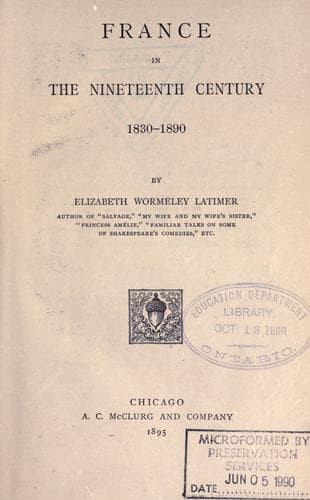
France in the Nineteenth CenturyLatimer, Elizabeth Wormeley
History
France in the Nineteenth Century
Latimer, Elizabeth Wormeley
France -- History -- 1789-1900
"I knew Madame de Teba in Madrid, and from what I saw of her there and
at Malaga, I do not doubt she is the most cultivated and interesting
woman in Spain. Young, beautiful, educated strictly by her mother, a
Scotchwoman,--who for this purpose carried her to London and kept
her there six or seven years,--possessing extraordinary talents, and
giving an air of originality to all she says and does, she unites
in a most bewitching manner the Andalusian grace and frankness to a
French facility in her manners and a genuine English thoroughness
in her knowledge and accomplishments. She knows the chief modern
languages well, and feels their different characters, and estimates
their literature aright. She has the foreign accomplishments of
singing, painting, playing, etc., joined to the natural one of
dancing, in a high degree. In conversation she is brilliant and
original, yet with all this she is a true Spaniard, and as full
of Spanish feelings as she is of talent and culture."
Washington Irving, in 1853, thirty-five years later, writing to
his nephew, speaks in equal praise of Madame de Teba.
"I believe I told you," he says, "that I knew the grandfather of
the empress, old Mr. Fitzpatrick. In 1827 I was in the house of his
son-in-law, Count Teba, at Granada, a gallant, intelligent gentleman,
much cut up in the wars, having lost an eye and been maimed in a
leg and hand. Some years after, in Madrid, I was invited to the
house of his widow, Madame de Montijo, one of the leaders of _ton_.
She received me with the warmth and eagerness of an old friend. She
claimed me as the friend of her late husband. She subsequently
introduced me to the little girls I had known in Granada, _now_
fashionable belles in Madrid."
In some lines of Walter Savage Landor, Madame de Montijo was addressed
as a "lode-star of her sex."
The Marquis de Montijo had been an adherent of Joseph Bonaparte
while the latter was king of Spain, and his eye had been put out
at the battle of Salamanca. He was a liberal in politics, and his
house was always open to cultivated men.
Such was the ancestry of the beautiful young lady who, tall, fair,
and graceful, with hair like one of Titian's beauties, was travelling
with her mother from capital to capital, after the marriage of her
sister to the Duke of Alva, and who spent the winters of 1850,
1851, and 1852 in the French capital. Mademoiselle Eugénie had
conceived a romantic admiration for the young prince who at Strasburg
and Boulogne had been so unfortunate. Her father had been a stanch
adherent of Bonaparte, and she is said to have pleaded with her
mother at one time to visit the prisoner at Ham and to place her
fortune at his disposal.
Public-domain text, read in full here on John Shaqi.
Reviews
Reviews
No reviews yet
Be the first to share your thoughts on this work.
Elsewhere in the archive
Join the Discussion
Join the discussion
Sign in to leave a comment or review.
Sign InorCreate an account