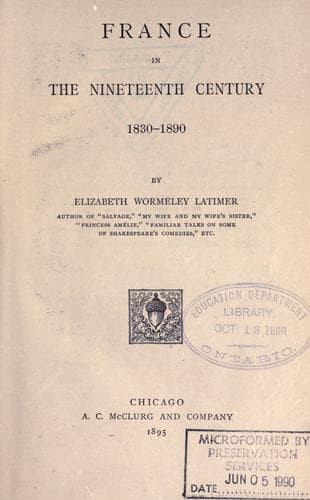
France in the Nineteenth CenturyLatimer, Elizabeth Wormeley
History
France in the Nineteenth Century
Latimer, Elizabeth Wormeley
France -- History -- 1789-1900
"The emperor thaws more and more. This evening after dinner I withdrew
with him to his sitting-room for half an hour before rejoining his
guests, in order that he might smoke his cigarette,--in which
occupation, to his amazement, I could not keep him company. He
told me that one of the deepest impressions ever made on him was,
when having gone from France to Rio Janeiro and thence to the United
States, and being recalled to Europe by the rumor of his mother's
serious illness, he arrived in London directly after King William's
death, and saw you going to open parliament for the first time."
Subsequently the prince tells the queen,--
"We discussed all topics of home and foreign policy, material and
personal, with the greatest frankness, and I can say but good of what
I heard.... He was brought up in the German fashion in Germany,--a
training which has developed a German turn of mind. As to all modern
political history, so far as this is not Napoleonic, he is without
information; so that he wants many of the materials for accurate
judgment."
Dickens, who was at Boulogne on this occasion, thus tells of Prince
Albert's arrival:--
"The town looks like one immense flag, it is so decked out with
streamers; and as the royal yacht approached yesterday, the whole
range of the cliff-tops was lined with troops, and the artillerymen,
matches in hand, stood ready to fire the great guns the moment
she made the harbor, the sailors standing up in the prow of the
yacht, the prince, in a blazing uniform, left alone on the deck for
everybody to see,--a stupendous silence, and then such an infernal
blazing and banging as never was heard. It was almost as fine a
sight as one could see, under a deep blue sky."
While the guest of the emperor, Prince Albert expressed to him
the queen's hope that they should see him in England, and that she
should make the acquaintance of the empress.
The prince, an excellent judge of character, in a subsequent memorandum
concerning his impressions, says,--
"The emperor appeared quiet and indolent from constitution, not
easily excited, but gay and humorous when at his ease. His French
is not without a little German accent, and his pronunciation of
German is better than of English.... He recited a poem by Schiller
on the advantages to man of peace and war, which seemed to have made
a deep impression upon him, and appeared to me to be not without
significance with reference to his own life. His court and household
are strictly kept and in good order, more English than French.
The gentlemen composing his _entourage_ are not distinguished by
birth, manners, or education. He lives on a familiar footing with
them, although they seemed afraid of him. The tone was rather that
of a garrison, with a good deal of smoking.... He is very chilly,
complains of rheumatism, and goes early to bed, takes no pleasure
in music, but is proud of his horsemanship."
Public-domain text, read in full here on John Shaqi.
Reviews
Reviews
No reviews yet
Be the first to share your thoughts on this work.
Elsewhere in the archive
Join the Discussion
Join the discussion
Sign in to leave a comment or review.
Sign InorCreate an account