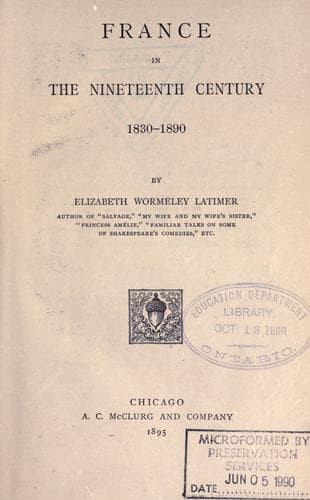
France in the Nineteenth CenturyLatimer, Elizabeth Wormeley
History
France in the Nineteenth Century
Latimer, Elizabeth Wormeley
France -- History -- 1789-1900
Speaking again of the emperor's lack of information as to the history
of politics, Prince Albert says:--
"But he is remarkably modest in acknowledging these defects, and
in not pretending to know what he does not. All that relates to
Napoleonic politics he has at his finger's ends. He also appears to
have thought much and deeply on politics, yet more like an amateur
politician, mixing many very sound and very crude notions together.
He admires English institutions, and regrets the absence of an
aristocracy in France, but might not be willing to allow such an
aristocracy to control his own power, whilst he might wish to have
the advantage of its control over the pure democracy."
The emperor closely questioned the prince about the working of
the English government and the queen's relations to her ministers.
Prince Albert writes,--
"He said that he did not allow his ministers to meet or to discuss
matters together; that they transacted their business solely with
him. He seemed astonished when I told him that every despatch went
through the queen's hands and was read by her, as he only received
extracts made from them, and indeed appeared to have little time
or inclination generally to read. When I observed to him that the
queen would not be content without seeing the whole of the diplomatic
correspondence, he replied that he found a full compensation in
having persons in his own employ and confidence at the different
posts of importance, who reported solely to him. I could not but
express my sense of the danger of such an arrangement, to which
no statesman, in England at least, would submit."
I have quoted this memorandum of Prince Albert's, because it points
out the perils which led to the downfall or the Empire,--the emperor's
bad _entourage_; his personal government, assisted only by private
confidential relations with irresponsible persons; his mixture of
crude and sensible ideas of government; his indolence; and his
tendency to let things slide out of his own hands.
"Upon the whole," concluded the prince, "my impression is that
neither in home nor foreign politics would the emperor naturally
take any violent step, but that he appears in distress for means
of governing, and is obliged to look about him from day to day.
Having deprived the people of any active participation in the
government, and reduced them to the mere position of spectators,
they grow impatient, like a crowd at a display of fireworks, whenever
there is any cessation in the display. Still, he appears the only
man who has any hold on France, relying on the name of Napoleon.
He said to the Duke of Newcastle:
'Former Governments have tried to reign by the support of one million
of the educated classes; I claim to lay hold of the other twenty-nine.'
He is decidedly benevolent, and anxious for the good of the people,
but has, like all rulers before him, a bad opinion of their political
capacity."
Public-domain text, read in full here on John Shaqi.
Reviews
Reviews
No reviews yet
Be the first to share your thoughts on this work.
Elsewhere in the archive
Join the Discussion
Join the discussion
Sign in to leave a comment or review.
Sign InorCreate an account