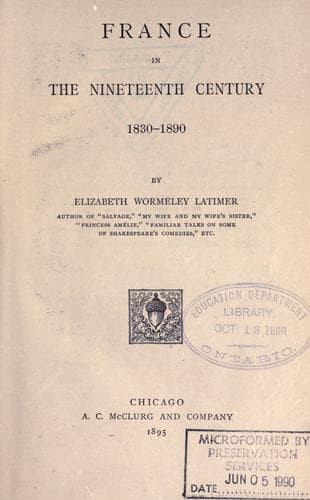
France in the Nineteenth CenturyLatimer, Elizabeth Wormeley
History
France in the Nineteenth Century
Latimer, Elizabeth Wormeley
France -- History -- 1789-1900
At the time of her marriage the princess had just entered her
seventeenth year. The wedding-day was made a little family fête at
Windsor, in spite of Prince Albert's absence. "The younger children,"
the queen writes to her husband, "are to have a half-holiday. Alice
is to dine with us for the first time, in the evening. We shall
drink the archduke's and the archduchess's healths, and I have
ordered wine for our servants, and grog for our sailors, to do the
same."
Maximilian had been round the world in his frigate, the "Novara;"
he had travelled into Greece and Asia Minor, he had visited Spain,
Portugal, and Sicily; he had been to Egypt and the Holy Land. He
loved the ocean like a true sailor, and in 1856 he had taken up his
residence at Trieste, to be near its shores. He would frequently
go out alone in a light boat, even in rough weather, a dash of
danger lending excitement to a struggle with the wind and waves.
One day in a storm his light craft had been borne like a feather
round Cape Gignano. In a moment it lay at rest under the lee of
the land. Maximilian landed, and found the spot so charming and the
sea-view so superb that he resolved to build a little villa there
for fishing. He bought the land at once, and began by setting out
exotics, persuaded that the soil of such a spot would be favorable
to tropical vegetation. A year later he brought his young bride to
this favored spot, and with a golden wand transformed his bachelor's
fishing-hut into the palace of an emperor.
At this period of his life, Maximilian (an author and a poet) was
greatly interested in architecture. He drew the plans for an exquisite
church (now one of the beauties of Vienna), and draughted with his
own hand those for the grounds and castle of Miramar. The work was
pushed on rapidly, yet in 1859, when Austria was forced to give up
Lombardy, nothing at Miramar was complete except a fancy farm-house
on one of the heights of the property. Maximilian, however, made
his home there with his wife, and they found it so delightful that
when at length the castle was ready for occupation, they lingered
in the farmhouse, which they loved as their first home. It was a
large Swiss châlet, covered with vines and honeysuckle, surrounded
by groves of camellias and pyrus japonicas. How delicious life
must have been to the husband and wife in this solitude, fragrant
with flowers, vocal with the songs of birds, a glory of greenness
round the house, the blue sky overhead, the glittering ocean at
their feet, and holy love and loving kindness everywhere around
them!
Maximilian's generosity rendered wealth indispensable to his complete
happiness, for he loved to surround himself with artists, learned
men, and men of letters. He paid them every kind of attention in
his power, and did not omit those little gifts which are "the beads
on memory's rosary."
Public-domain text, read in full here on John Shaqi.
Reviews
Reviews
No reviews yet
Be the first to share your thoughts on this work.
Elsewhere in the archive
Join the Discussion
Join the discussion
Sign in to leave a comment or review.
Sign InorCreate an account