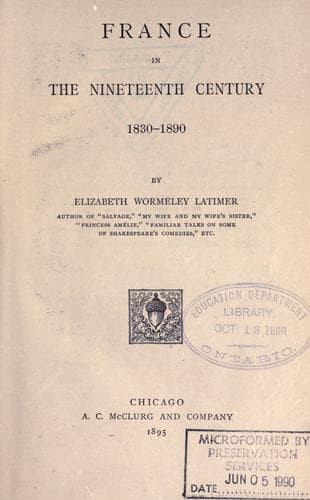
France in the Nineteenth CenturyLatimer, Elizabeth Wormeley
History
France in the Nineteenth Century
Latimer, Elizabeth Wormeley
France -- History -- 1789-1900
"One feels how happy life must have been to husband and wife in
this new Paradise!" cries M. Victor Tissot. "Yet it was Paradise
Lost before long, for alas! in this, as in the other Paradise,
the Eve, the sweet young wife, was tempted by ambition. She took
the apple, ate, and gave it to her husband."
On April 10, 1864, the Mexican deputies commissioned to offer Maximilian
the imperial crown, arrived at Miramar. "We come," said Don Gutierrez
de Estrada, "to beseech you to ascend the throne of Mexico, to which
you have been called by the voice of a people weary of anarchy
and civil war. We are assured you have the secret of conquering
the hearts of all men, and excel in the rare knowledge of the art
of government."
Maximilian replied that he was ready to accept the honor offered
him by the Mexican people, and that his government would be both
liberal and constitutional. "I shall prove, I trust," he said,
"that liberty may be made compatible with law. I shall respect your
liberties, and uphold order at the same time."
Don Gutierrez thanked the archduke in the name of the Mexican nation,
and then the new emperor swore upon the Gospels to labor for the
happiness and prosperity of his people, and to protect their independent
nationality. Don Gutierrez was then embraced by Maximilian, who
hung around his neck the cross of the new Order of Guadeloupe,
of which he was the first member.
But this acceptance of the imperial crown of Mexico was by no means
a sudden thought with Maximilian. For eight months he had been
debating the matter in his own heart, urged to acceptance of the
crown by his wife, but dissuaded by his family.
The history of the offer, connected as it is with one of Napoleon
III.'s schemes for extending French influence, must be briefly
told.
Before the Civil War broke out in America, it had already entered
the head of the emperor that he would like to intermeddle in the
affairs of Mexico. That unhappy country, which the United States
have been accused of doing their best to keep in a chronic state
of weakness, turbulence, and revolution, had been left to recover
itself after the Mexican War, which had shorn away its fairest
provinces.
Public-domain text, read in full here on John Shaqi.
Reviews
Reviews
No reviews yet
Be the first to share your thoughts on this work.
Elsewhere in the archive
Join the Discussion
Join the discussion
Sign in to leave a comment or review.
Sign InorCreate an account