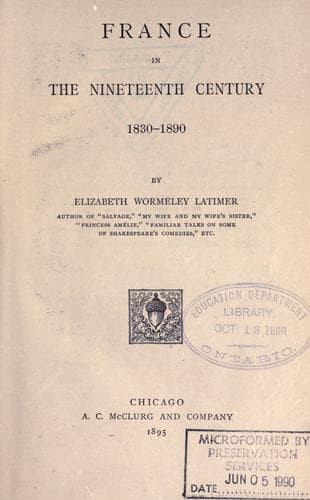
France in the Nineteenth CenturyLatimer, Elizabeth Wormeley
History
France in the Nineteenth Century
Latimer, Elizabeth Wormeley
France -- History -- 1789-1900
It was not until after the Empress Eugénie had been left regent
of France, during the campaign of Italy, in 1859, that she took
any part in politics; but from that time her influence was freely
exercised, though she interested herself chiefly in foreign affairs.
She did not like Victor Emmanuel, nor her husband's policy as regarded
Italy. She dreaded the destruction of the pope's power as a temporal
prince. Her sympathies were Austrian, and in conjunction with her
friends the Prince and Princess Metternich she lost no opportunity of
urging the establishment of Maximilian and Carlotta on the imperial
throne of Mexico. She looked upon this as in some sort a compensation
given by France to the House of Hapsburg for its losses in Italy.
To her imagination, the expedition to Mexico seemed like a romance.
She saw two lovers seated upon Montezuma's throne,--the oldest throne
in the New World,--surrounded by the glories of the tropics. When
there, they would restore the privileges of the Catholic clergy, and
would curb the revolutionary aspirations of the mongrel population of
Mexico,--a population which, as a Spaniard, she hated and despised.
To this end she intrigued with all her heart. Indeed, she and her
friends the Metternichs acted in the preliminary arrangements of
the plan the part of actual conspirators.
After the French and Spanish forces landed in Mexico, accompanied
by a few Englishmen, Juarez offered to make compensation for the
wrongs complained of, and an agreement was drawn up and signed
by General Prim and the French and English commanders at a place
called La Soledad.
England and Spain, when the agreement was sent to Europe for
ratification, considered it satisfactory. France, having ulterior
designs, repudiated it altogether. The Spaniards and the English
therefore withdrew their forces, and the French remained to fight
out the quarrel with Juarez alone.
Up to this time no allusion had been made as to any change in the
Mexican government; but now French agents began to intrigue in
favor of an empire and Maximilian. A small assembly of Mexican
notables was with great difficulty convened in the city of Mexico,
from which Juarez was absent, being engaged in carrying on the
war. The only persons concerned in this assembly who took any real
interest in its objects were the clergy, who believed that a prince
of the House of Austria would be likely to restore to them all
their property and privileges.
Public-domain text, read in full here on John Shaqi.
Reviews
Reviews
No reviews yet
Be the first to share your thoughts on this work.
Elsewhere in the archive
Join the Discussion
Join the discussion
Sign in to leave a comment or review.
Sign InorCreate an account