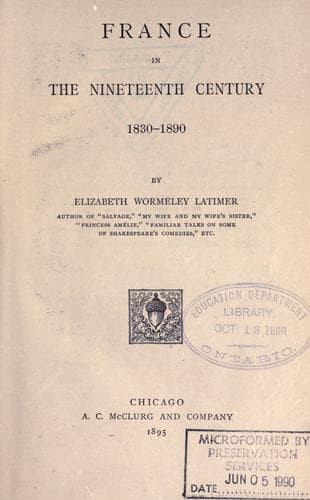
France in the Nineteenth CenturyLatimer, Elizabeth Wormeley
History
France in the Nineteenth Century
Latimer, Elizabeth Wormeley
France -- History -- 1789-1900
There can be no doubt that such a government as Maximilian would
have established in Mexico would have been a happy thing for that
country and for civilization; but it is equally certain that the
Mexicans (meaning by that term the great mass of the people) did
not want such a government. Above all, they did not want for their
ruler a foreigner, backed by a foreign potentate. The only _raison
d'être_ for Maximilian's government in any Mexican's mind was not
that it would bring order and peace into the country, but that
it might bring money from the coffers of the new emperor's ally.
But when, after a while, the reverse of peace and order was the
result of this new government, and when the French emperor declined
to advance any more funds, nothing kept any man true to Maximilian
but the dread of what the party of Juarez might do to him when
the cause of the emperor should be overthrown.
With this explanation we will go back to Miramar, where Maximilian
and Carlotta, unquestionably deceived by the political manipulations
of the French emperor, believed, with joy and pride, that they
were the choice of the Mexican people, and that they had nothing
to do but to go forth and take possession of the promised land.
On April 13, 1864, almost the darkest date during our war for the
cause of the Federal Union, the Archduke Maximilian and his wife
quitted the soil of Austria.
Early in the morning, in the port of Trieste and on the road to
Miramar, all were astir. Friends from all parts of the Austrian
Empire were hastening to bid farewell to the Archduke whom they
loved.
The "Novara" and the French frigate "Thémis" were lying off Trieste,
ready to start; and near them, riding at anchor, were six steamships
belonging to the Austrian Lloyds, full of spectators.
At about one o'clock P. M. the emperor, with his wife leaning on
his arm, entered the town-hall of Trieste, where about twenty
deputations were assembled to offer him farewell addresses. Maximilian
was much moved, and when the burgomaster spoke of the grief that
all the people of the city would feel at his departure, he burst
into tears. He embraced the burgomaster, shook hands with those
about him, and whispered, as if to himself: "Something tells me
that I shall never see this dear country more." His sensitive and
poetic nature was very susceptible to sad presentiments; his book
teems with them.
After the leave-taking, their Majesties entered the magnificent
barge prepared for their use by the city of Trieste; a salute of
one hundred guns reverberated from the sides of the mountain, while
twenty thousand hats and handkerchiefs waved a sad farewell.
Public-domain text, read in full here on John Shaqi.
Reviews
Reviews
No reviews yet
Be the first to share your thoughts on this work.
Elsewhere in the archive
Join the Discussion
Join the discussion
Sign in to leave a comment or review.
Sign InorCreate an account