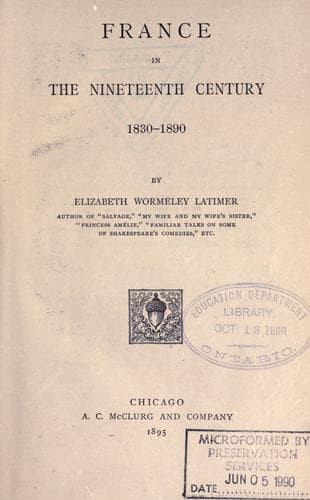
France in the Nineteenth CenturyLatimer, Elizabeth Wormeley
History
France in the Nineteenth Century
Latimer, Elizabeth Wormeley
France -- History -- 1789-1900
Princess Salm-Salm, in the last act of this tragedy, showed herself
to be a brave and generous woman. When her husband left the capital
she had crossed the enemy's lines in order to get out of Mexico,
but was twice in danger of being shot by the soldiers of Diaz.
She was accused of supplying money to a troop of Austrian soldiers
who, having been captured, were confined at Chapultepec, and she
was imprisoned at Guadalupe. After a short detention, however,
she obtained leave to quit Mexico for Europe; but changing her
route, she managed to rejoin her husband at Queretaro. Thence,
hiding by day and travelling by night, she made her way back to
San Luis de Potosi, where Juarez had his headquarters. She threw
herself at his feet, and implored his mercy for the emperor; but
Juarez told her (not without some signs of compassion) that he
felt no inclination to spare his life, and that if he were willing
to do so, he would not be permitted by his followers to show him
any clemency.
When Maximilian heard of this brave enterprise on his behalf, he
could not refrain from tears.
The prisoners were three weeks at La Capuchina, in complete uncertainty
as to what would be done with them. Indeed, the Juarists seemed much
embarrassed by their prize. On June 10 they were informed that
Juarez had sent an order to have them tried by a court-martial,
which would be held on the 12th of June.
"Where are you going to take me?" asked Maximilian on that day of
the officer who came to escort him. "To the court-martial," was
the reply. "Where is it held?" said Maximilian. "In the theatre."
"Then I refuse to accompany you. I will not be made a public spectacle
at a theatre. You may go alone."
The officer, not being authorized to use force, went away. The
trial proceeded without the presence of the prisoner. Generals
Miramon and Mejia, however, were dragged upon the stage where the
court-martial was sitting. The play-house was crowded with spectators.
It was a tragedy with no admission-fee. The proceedings lasted
three days. The emperor was accused of usurpation, of instigating
civil war, and of causing the death of forty thousand patriots,
hanged or shot in consequence of his order of October 3, intended
to operate only against armed bands of robbers.
On the morning of June 15, 1867, General Escobedo presented himself
in the prison, holding the sentence of the court-martial in his
hand. Maximilian, who could guess his fate, said quietly: "Read
it, General; I am ready to hear you."
Maximilian, Miramon, and Mejia were condemned to be shot.
"I understand you," said the emperor, with perfect calmness. "The
law of October 3 was made to put down robbers: this sentence is
the work of murderers."
Escobedo laid his hand on his revolver with a sudden exclamation.
Then, recovering himself, he said sarcastically: "I suppose that
a criminal must be allowed the right to vilify his judges."
Maximilian turned his back on him, and Escobedo left the prison.
Public-domain text, read in full here on John Shaqi.
Reviews
Reviews
No reviews yet
Be the first to share your thoughts on this work.
Elsewhere in the archive
Join the Discussion
Join the discussion
Sign in to leave a comment or review.
Sign InorCreate an account