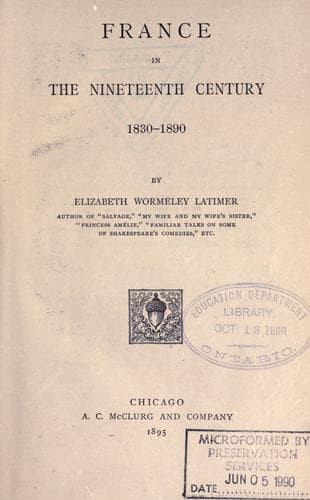
France in the Nineteenth CenturyLatimer, Elizabeth Wormeley
History
France in the Nineteenth Century
Latimer, Elizabeth Wormeley
France -- History -- 1789-1900
The execution had been ordered for the next morning, but was put
off till the 19th, by order of Juarez.
Meantime the English and Prussian ambassadors hastened to Juarez,
hoping to obtain mercy for the late emperor. The French and Austrian
courts, by telegraph, implored the mediation of the United States.
There was no American minister at that time in Mexico, but Mr.
Seward sent telegraphic despatches to Juarez, pointing out that the
execution of Maximilian would rouse the feelings of the civilized
world against the Mexican Republic.
All was of no avail. The idea of foreign intervention in the affairs
of Mexico was so distasteful to the Mexicans that these pleadings on
the late emperor's behalf by foreign Governments only accelerated
his fate.
During the night before his death, Maximilian asked his jailers
for a pair of scissors. He was refused. Then he implored one of
them to cut off a lock of his hair. When that was done, he wrote
the following pathetic letter to Carlotta:--
MY BELOVED CARLOTTA,--If God should permit you one
of these days to get well enough to read these lines, you will
know how sad has been my fate ever since your departure.
You took with you my happiness, my very life, and my good
fortune. Why did I not take your advice? So many sad things
have taken place, so many unexpected catastrophes and
undeserved misfortunes have fallen on me, that I have now lost
heart and hope, and look upon death as my good angel.
My death will be sharp and sudden, without pain. I shall fall
gloriously, like a soldier, like a conquered sovereign....
If you cannot, dearest, bear up under your load of sorrow,
if God in His mercy soon reunites us by your death, I will
bless His fatherly hand, which now seems very heavy upon
me. Adieu, adieu!
YOUR POOR MAX.
He kissed this letter, folded into it the light silky lock of his
own hair, and placed it with other letters which he had written
to his mother and friends. They were all in French, and written
in a clear, firm, regular hand. His noble nature shone in every
line. They give the key to the irresistible personal sympathy he
inspired in all who knew him. His enemies were aware of this, and
no judge or general who had ever known him sat on his court-martial.
As six o'clock was striking on the morning of June 19, the door
of the prison was unbarred. "I am ready," said Maximilian.
As he stepped forth from the door of the convent, he exclaimed:
"What a beautiful morning! I have always fancied I should like
to die in sunshine,--on a summer day."
Public-domain text, read in full here on John Shaqi.
Reviews
Reviews
No reviews yet
Be the first to share your thoughts on this work.
Elsewhere in the archive
Join the Discussion
Join the discussion
Sign in to leave a comment or review.
Sign InorCreate an account