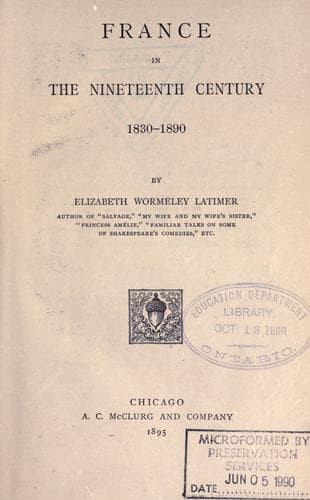
France in the Nineteenth CenturyLatimer, Elizabeth Wormeley
History
France in the Nineteenth Century
Latimer, Elizabeth Wormeley
France -- History -- 1789-1900
He entered the carriage in waiting. Miramon and Mejia followed
him, with the priest who attended them in their last moments. They
were escorted by a body of four thousand men, and were driven to
the same rocky height on which they had been captured, called the
Cerro della Campana. They sat upright in the carriage during the
drive, with proud smiles upon their faces. They were carefully
dressed, as if for an occasion of festivity. The population of
the place was all abroad to see them pass, and looked at them with
silent pity and admiration. The calmness and self-possession of the
emperor, about to die, touched even the most indifferent spectators.
The women freely shed tears.
Maximilian was a handsome, striking-looking man. His beautiful light
hair was parted by a straight line from his forehead to the nape
of his neck. His blue eyes were clear and soft, with a beseeching
look in them. His hands were beautifully white, his fingers elegant
and taper.
As they neared the place of execution, General Mejia suddenly turned
pale, covered his face, and with a sob fell back in his place in the
carriage. He had caught sight of his wife, agonized, dishevelled,
with her baby in her arms, and all the appearance of a madwoman.
The party arrived at the foot of the little hill. The emperor sprang
out, brushed off some dust which had settled on his clothes, and
going up to the firing party, gave each man an ounce of gold. "Take
good aim, my friends," he said. "Do not, if possible, hit me in
the face, but shoot right at my heart."
One of the soldiers wept. Maximilian went to him, and putting his
cigar-case, of silver filigree, into his hand, said: "Keep that,
my friend, in remembrance of me. It was given to me by a prince
more fortunate than I am now."
The non-commissioned officer then came near, and said he hoped
that he would forgive him. "My good fellow," replied Maximilian,
cheerfully, "a soldier has but to obey orders; his duty is to do
his duty."
Then, turning to Miramon and Mejia, he said: "Let me, true friends,
embrace you for the last time!" He did so, and then added: "In a
few minutes we shall be together in a better world."
Turning to Miramon, he said: "General, the bravest man should have
the place of honor. Take mine."
Mejia being very much cast down by the sad spectacle presented
by his poor, distracted wife, Maximilian again pressed his hands,
saying: "God will not abandon our suffering survivors. For those
who die unjustly, things will be set right in another world."
The drums began to beat. The end was near. Maximilian stepped forward,
mounted on a stone, and addressed the spectators.
Public-domain text, read in full here on John Shaqi.
Reviews
Reviews
No reviews yet
Be the first to share your thoughts on this work.
Elsewhere in the archive
Join the Discussion
Join the discussion
Sign in to leave a comment or review.
Sign InorCreate an account