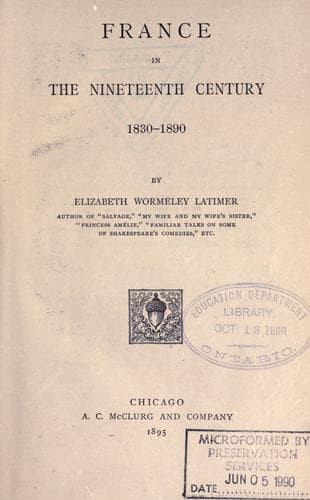
France in the Nineteenth CenturyLatimer, Elizabeth Wormeley
History
France in the Nineteenth Century
Latimer, Elizabeth Wormeley
France -- History -- 1789-1900
One of the most remarkable sights of that gay time of hollowness
and brilliancy was the review given in honor of the Emperor of
Russia, on June 6. No less than sixty thousand French troops, of
all arms of the service, filed past the three grand-stands on the
race-course of the Bois de Boulogne. On the central stand sat the
Empress Eugénie, with the Prince Imperial, the Crown Princess of
Prussia, her sister, Princess Alice, and the Grand Duchess of
Leuchtenberg. Before this stand, on horseback on one side, sat the
Grand Duke Vladimir, the Czarevitch (the present Czar of Russia),
the Crown Prince of Prussia (since the lamented Emperor Frederick),
Prince Gortschakoff (the Russian prime minister), Count Bismarck, and
an English nobleman; on the other side were the Duc de Leuchtenberg,
the Duke of Mecklenburg, and the Prince of Hesse Darmstadt; while
in the centre of them all rode the czar, with Napoleon III. on
one hand, and on the other the king of prussia.[1]
[Footnote 1: Blackwood's Magazine.]
How little could any of those who looked upon that throng of royal
personages imagine what in little more than two years was coming
on them all!
The emperor was fond of literature, and when drawn into a literary
discussion, his half-closed eyes would gleam with sudden light,
and his criticisms would be both witty and valuable. During his
later years, harassed by sickness and perplexities of all kinds,
his greatest pleasure was to shut himself up in his study, and
there work upon his "Life of Cæsar." He wrote it entirely himself,
though he had many learned men in France and Germany employed in
looking up references and making extracts for him. The book was
considered a work of genuine merit. To its author it was a labor of
love. He threw into it all his experience of life, all his theories,
all his Napoleonic convictions; for in Cæsar and Napoleon he found
many parallels. He hoped to be admitted as a literary man into the
French Academy, and he meant to base his claim upon this book.
Public-domain text, read in full here on John Shaqi.
Reviews
Reviews
No reviews yet
Be the first to share your thoughts on this work.
Elsewhere in the archive
Join the Discussion
Join the discussion
Sign in to leave a comment or review.
Sign InorCreate an account