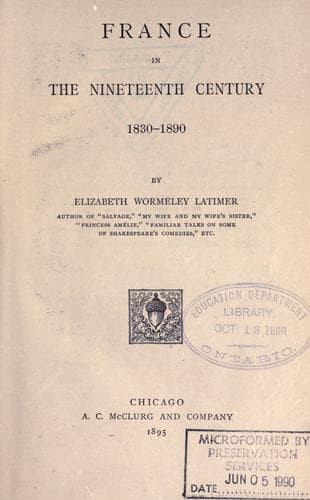
France in the Nineteenth CenturyLatimer, Elizabeth Wormeley
History
France in the Nineteenth Century
Latimer, Elizabeth Wormeley
France -- History -- 1789-1900
I have said nothing of the cares that oppressed the emperor in
connection with the war in the Crimea, which was prolonged far
beyond his expectations; of the campaign in Italy, broken short
off by threats of intervention made by the king of Prussia, and
followed by feelings of disappointment and revenge on the part of
the Italians; of the intervention of the emperor in 1866, after
the battle of Sadowa, to check the triumphant march of the Prussian
army through Austria; nor of the bombs of Orsini, which led to a
rupture of the friendliness between France and England, breaking
up the cordial relations which existed between the two courts in
1857, and reviving that panic about French invasion which seems
periodically to attack Englishmen ever since the great scare in
the days of Bonaparte. These subjects belong rather to historical
reminiscences of England, Italy, or Germany; but the emperor had
anxieties besides in France, and often found it hard to regulate
with discretion even the ways of his own household.
The empress, who after she had governed France as regent in 1859,
during her husband's absence in the Italian war, had been admitted
to councils of state, by no means approved either her husband's
domestic or foreign policy. We have seen that her influence was
strongly exerted to bring about the unfortunate attempt to give
an emperor and empress to Mexico; but on two other points that
she had at heart she failed. She could not persuade her husband
to undertake the reconstruction of the kingdom of Poland, nor to
assist Queen Isabella of Spain when her subjects, exasperated at
last by her excesses, drove her over the French frontier. The empress
disliked many of the coterie who enjoyed her husband's intimacy,
especially his cousin, Prince Napoleon. She resented the prince's
opposition to her marriage; she disliked his manners, his political
opinions, his aggressive opposition to all the offices of religion;
and she succeeded in detaching him from the emperor's confidence,
and in hindering his taking part in public affairs. To his wife--the
Princess Clotilde--she was deeply attached; but that did not serve to
reconcile her to the prince, her husband. Both ladies were opposed
to any diminution of the pope's temporal power in Italy; but the
private circle of the friends of the empress was too gay for the
chastened nature of the Princess Clotilde, and by degrees her intimacy
with the empress became less close and affectionate than it had
been in the early days of her unhappy marriage.
Public-domain text, read in full here on John Shaqi.
Reviews
Reviews
No reviews yet
Be the first to share your thoughts on this work.
Elsewhere in the archive
Join the Discussion
Join the discussion
Sign in to leave a comment or review.
Sign InorCreate an account