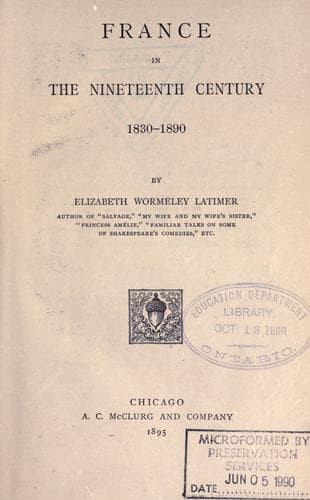
France in the Nineteenth CenturyLatimer, Elizabeth Wormeley
History
France in the Nineteenth Century
Latimer, Elizabeth Wormeley
France -- History -- 1789-1900
It seems, too, as if the world forgets now--what assuredly must
be remembered hereafter in history--that it was he who relieved
Europe from the treaties of Vienna, and asserted the claims of
nationalities; that he brought about the resurrection of Italy;
that through his policy we have a solution satisfactory to the world
in general of the question of the pope's power as a temporal prince
in Italy; that he was the builder of modern Paris, the promoter of
agriculture, the railroad king of France, the peasant's and the
workman's friend.
In early life he had been an adventurer; but a kind heart gave
him gracious manners. He was grateful, faithful, and generous;
terribly prodigal of money, and the victim of the needy men by whom
he was surrounded. It seems as if, in spite of his _coup d'état_
(which, subtracting its massacres, may have been a measure of
self-preservation), he deserves better of the world and of France
than to have his memory spurned and spat upon, as men do now.
He gave France eighteen years of pre-eminent prosperity; he left
her, to be sure, in ruins. In his fall he utterly obliterated the
prestige of the name of Bonaparte. No Bonaparte, probably, will ever
again awaken the enthusiasm of the French people,--an enthusiasm which
Napoleon III. relied on, justly at first, and fatally afterwards,
when a generation had arisen in France, from whom the feeling had
passed away.
The emperor's malady, which was slowly sapping his strength, is said
to be the most painful one that flesh is heir to. Every movement was
pain to him. Absolute rest was what he needed, but cares pressed
hard upon him on every side. He must die, and leave his empire in
the hands of a woman and a child. His government had been wholly
personal. He could not transmit his power, such is it was, to any
other person,--least of all could he place it in feeble hands.
There were no props to his throne. No Bismarck or Cavour stood
beside him, to whom he might confide his wife and son, and feel
that though his hand no longer held the helm, the ship would sail
straight on the course he had laid down for her. The men about
him were third and fourth rate men,--all of them enormously his
own inferiors. They cheated and deceived and plundered him; and he
knew it in a measure, though not as he knew it after his downfall.
Public-domain text, read in full here on John Shaqi.
Reviews
Reviews
No reviews yet
Be the first to share your thoughts on this work.
Elsewhere in the archive
Join the Discussion
Join the discussion
Sign in to leave a comment or review.
Sign InorCreate an account