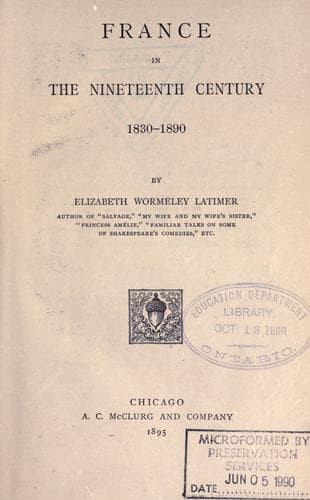
France in the Nineteenth CenturyLatimer, Elizabeth Wormeley
History
France in the Nineteenth Century
Latimer, Elizabeth Wormeley
France -- History -- 1789-1900
An episode in the private life of the palace, in 1859, created
considerable friction in Paris, and provoked remonstrances from
the emperor's ministers.[1] This was the admission to the circle
of intimates who surrounded the empress of the mesmerist and medium
Home. This man gave himself out to be an American; but many persons
suspected that his native land was Germany, and some said he was a
secret agent of that court, which had emissaries all over France,
in search of useful information. The empress, having heard of Home's
strange feats of table-turning and spirit-rapping in fashionable
_salons_ of the capital, was eager to witness his performances. The
women in the high society of Paris were greatly excited about them.
Spiritualism was the fad of the season, and the empress caught the
infection. The emperor, who was present at many of the exhibitions
at the Tuileries, was also, it is said, much impressed by some
of them, especially by a mysterious invisible hand laid firmly
on his shoulder, and by an icy breath that passed over his face.
But although the emperor, always indulgent to his wife, resisted
at first the advice of his counsellors to get rid of Home, he was
forced at last to put an end to the _séances_ at the Tuileries,
Fontainebleau, and Biarritz. The spirits "summoned" had had the
imprudence to obtrude upon him their own views of his policy. When
the alliance with Italy and a probable war with Austria were under
discussion in the cabinet, the spirit-inspired pencil at the Tuileries
scrawled these words: "The emperor should declare war and deliver
Italy from the Austrians." Not long afterwards, the vulgar presumption
of Home, who had accompanied the court to Biarritz, provoked the
emperor, and caused him to give ear to the earnest remonstrances of
his Minister for Foreign Affairs. He gave orders that Home should
appear at the Tuileries no more.
[Footnote 1: Pierre de Lana.]
Home died not long after in Germany, forgotten by the world of
fashion, but leaving behind him a little circle of ardent believers.
The story of the emperor's later life seems to me to be one full
of pathos and of pain. It is the record of a man who knew himself
to be slowly dying, whose physical strength was ebbing day by day,
but who was bearing up under the vain hope of accomplishing the
impossible. One admires his extreme patience, his uncomplaining
perseverance, as he tried to roll the stone of Sisyphus, yet with
unspoken misgivings in his heart that it would escape from him and
crush the hopes of his life, as it rolled back out of his hands.
"Poor emperor!" says the eye-witness who beheld him in his hour
of triumph, before the grand-stand, in 1867, at the great review.
"He was a friend to all, and he fell through his friends. He was
very true to England, whatever he may have been to other countries;
but England failed him, unfortunately in Denmark, fortunately in
Mexico, and fatally in 1870."[1]
[Footnote 1: Blackwood's Magazine.]
Public-domain text, read in full here on John Shaqi.
Reviews
Reviews
No reviews yet
Be the first to share your thoughts on this work.
Elsewhere in the archive
Join the Discussion
Join the discussion
Sign in to leave a comment or review.
Sign InorCreate an account