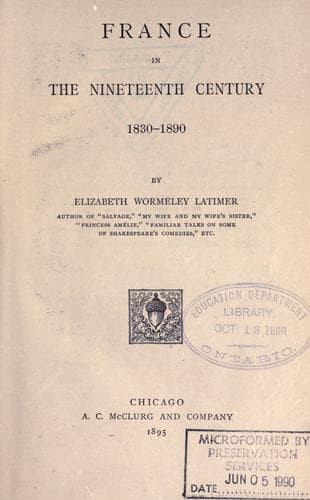
France in the Nineteenth CenturyLatimer, Elizabeth Wormeley
History
France in the Nineteenth Century
Latimer, Elizabeth Wormeley
France -- History -- 1789-1900
In the midst of the emperor's other perplexities, there came, during
the first days of 1870, a most damaging occurrence connected with
his own family,--an occurrence with which the emperor had no more
to do than Louis Philippe had had with the Praslin murder; but it
helped to impair the remaining prestige which clung to the name
of Bonaparte.
Prince Pierre Bonaparte, grandson of Lucien, was a dissolute and
irregular character. His cousin, the emperor, had repeatedly paid
his debts and given him, as he did to every one connected with the
name of Bonaparte, large sums of money. At last Prince Pierre's
conduct grew so bad that this help ceased. Then he threatened his
cousin; but the emperor would not even buy an estate he owned in
Corsica. Prince Pierre went back, therefore, to the cradle of his
family, and there got into a fierce quarrel with an opposition
member of the Chamber of Deputies. The deputy, like a true Corsican,
nourished revenge. He waited till he went up to Paris, and there
laid his grievances against the emperor's cousin before his fellow
deputies of the opposition. They at once made it a party affair.
On Jan. 2, 1870,--the day the reformed Chamber of Deputies was
opened,--two journalists of Paris, M. de Tourvielle and M. Victor
Noir, went armed to Pierre Bonaparte's house at Auteuil to carry
him a challenge. They found the prince in a room where he kept
a curious collection of weapons. He was a coarse man, with an
ungovernable temper. High words were exchanged. Victor Noir slapped
the prince in the face, and the prince, seizing a pistol, shot
him dead. He then turned on M. de Tourvielle; but the latter had
time to draw a sword from his sword-cane, and stood armed. Victor
Noir's funeral was made the occasion of an immense republican
demonstration, and M. Rochefort reviled the emperor and all his
family in the newspaper he edited, "La Lanterne," calling upon
Frenchmen to make an end of the Bonapartes.
Prince Pierre was tried for murder, and acquitted; Rochefort was
tried for seditious libel, and condemned. It was an ominous opening
for the new Chamber. The emperor had been most anxious that it
should contain no deputies violently opposed to his new policy,
and the elections had been scandalously manipulated in the interest
of his dynasty.
Thiers complained bitterly to an Englishman, who visited him, of
the undisguised tampering with voters in this election. He said,--
Public-domain text, read in full here on John Shaqi.
Reviews
Reviews
No reviews yet
Be the first to share your thoughts on this work.
Elsewhere in the archive
Join the Discussion
Join the discussion
Sign in to leave a comment or review.
Sign InorCreate an account