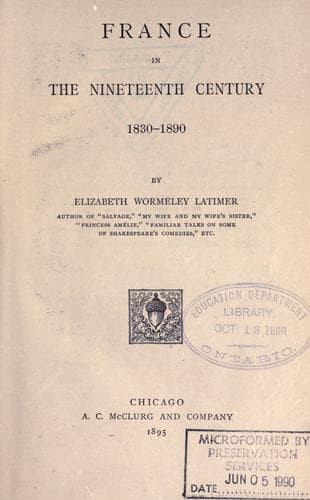
France in the Nineteenth CenturyLatimer, Elizabeth Wormeley
History
France in the Nineteenth Century
Latimer, Elizabeth Wormeley
France -- History -- 1789-1900
"The Government pretends to believe in a Chamber elected by universal
suffrage, and yet dares not trust the votes of the electors; but
mark my words, this tampering with an election is for the last
time. What will succeed the Empire, I know not. God grant it may
not be our country's ruin! But the state of things under which we
live cannot last long. It is incumbent on honest men to lay before
the emperor the state of the country, which his ministers do their
best to keep from him. For a long time I kept silent,--it was no
use to knock one's head against a wall; but now we have revolution
staring us in the face, as the alternative with the Empire."
As the little man said this, we are told that the fire in his eyes
gleamed through his spectacles; and as he walked about the room,
he seemed to grow taller and taller.[1]
[Footnote 1: Blackwood's Magazine.]
The new constitutional ministry, into whose hands the emperor proposed
to resign despotic power and to rule thenceforward as constitutional
sovereign, had for its chief M. Émile Ollivier; Marshal Le Boeuf
(made marshal on the field of Magenta) was the Minister of War.
The debates in the Chamber were all stormy. The opposition might
not be numerous, but it was fierce and determined. It scoffed at
the idea of France being free when elections were tampered with
to sustain the Government; and finally things came to such a pass
that the emperor resolved to play again his tromp-card, and to
call a _plébiscite_ to say whether the French people approved of
him and wished to continue his dynasty. They were to vote simply
Yes or No.
There was not such open tampering this time with the vote as there
had been in the election of the deputies, but all kinds of Government
influences were brought to bear on prefects, _maires_, and other
official personages, especially in the villages. The result was
that 7,250,000 Frenchmen voted Yes, and one and a half million,
No. But to the emperor's intense surprise and mortification, and in
spite of all precautions, there were 42,000 Noes from the army. It
was a terrible discovery to the emperor that there was disaffection
among his soldiers. Promotion, many men believed, had for some years
been distributed through favoritism. The men had little confidence
in their officers, the officers complained loudly of their men. A
dashing exploit in Algeria made up for irregularities of discipline.
Even the staff officers were deficient in geography, and the stories
that afterwards came to light of the way in which the War Department
collected worthless stores, while serviceable ones existed only on
paper, seem almost incredible. Yet when war was declared, Émile
Ollivier said that he went into it with a light heart, and Marshal
Le Bœuf was reported to have told the emperor that he would not
find so much as one button missing on his soldiers' gaiters.
Public-domain text, read in full here on John Shaqi.
Reviews
Reviews
No reviews yet
Be the first to share your thoughts on this work.
Elsewhere in the archive
Join the Discussion
Join the discussion
Sign in to leave a comment or review.
Sign InorCreate an account