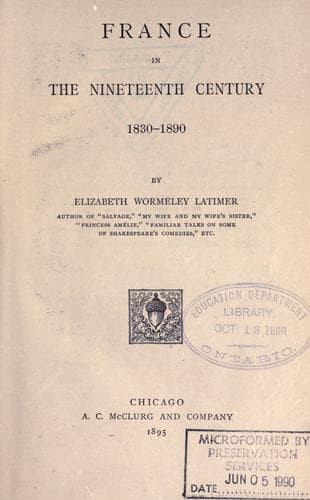
France in the Nineteenth CenturyLatimer, Elizabeth Wormeley
History
France in the Nineteenth Century
Latimer, Elizabeth Wormeley
France -- History -- 1789-1900
From Rambouillet the king had sent his approbation of the appointment
of the Duke of Orleans as lieutenant-general during the minority
of Henri V. Louis Philippe's answer to this communication so well
satisfied the old king that he persuaded the dauphin to join with
him in abdicating all rights in favor of Henri V., the little Duc
de Bordeaux. Up to this moment Charles seems never to have suspected
that more than such an abdication could be required of him. But
by this time it was evident that the successful Parisians would
be satisfied with nothing less than the utter overthrow of the
Bourbons. Their choice lay between a constitutional monarchy with
Louis Philippe at its head, or a renewal of the attempt to form
a republic.
The populace, on hearing that the abdication of the king and of the
dauphin had been announced to the Chamber of Deputies, assembled
to the number of sixty thousand, and insisted on the trial and
imprisonment of the late king. Hearing this, the royal family left
the Château de Maintenon the next morning, the king and the Duchesse
d'Angoulême taking leave of their faithful troops, and desiring
them to return to Paris, there to make their submission to the
lieutenant-general, "who had taken all measures for their security
and prosperity in the future."
During the journey to Dreux, Charles X. appeared to those around
him to accept his misfortunes from the hand of Heaven. The Duchesse
d'Angoulême, pale and self-contained, with all her wounds opened
afresh, could hardly bring herself to quit France for the third
time. Her husband was stolid and stupid. The Duchesse de Berri
was almost gay.
Meantime old stories were being circulated throughout France
discrediting the legitimacy of the Duc de Bordeaux, the posthumous
son of the Duc de Berri. He had been born seven months after his
father's death, at dead of night, with no doctor in attendance,
nor any responsible witnesses to attest that he was heir to the
crown. Louis Philippe had protested against his legitimacy within
a week after his birth. There was no real reason for suspecting his
parentage; nobody believes the slander now, but it is not surprising
that in times of such excitement, with such great interests at
stake, the circumstances attending his birth should have provoked
remark. They were both unfortunate and unusual.
Charles X. was the calmest person in the whole royal party. He
was chiefly concerned for the comfort of the rest. The dauphine
wept, her husband trembled, the children were full of excitement
and eager for play. Charles was unmoved, resigned; only the sight
of a tricolored flag overcame him.
He complained much of the haste with which he was escorted through
France to Cherbourg; but that haste probably insured his safety.
At Cherbourg two ships awaited him,--the "Great Britain" and the
"Charles Carroll;" both were American-built, and both had formed
part of the navy of Napoleon.
Public-domain text, read in full here on John Shaqi.
Reviews
Reviews
No reviews yet
Be the first to share your thoughts on this work.
Join the Discussion
Join the discussion
Sign in to leave a comment or review.
Sign InorCreate an account