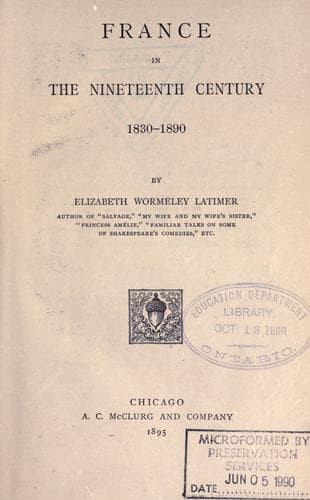
France in the Nineteenth CenturyLatimer, Elizabeth Wormeley
History
France in the Nineteenth Century
Latimer, Elizabeth Wormeley
France -- History -- 1789-1900
The discovery that the army was not to be depended on, and needed
a war of glory to put it in good humor with itself and with its
emperor, decided Napoleon III. to enter precipitately into the
Franco-Prussian war while he still had health enough to share in
it. Besides this, a struggle with Germany was inevitable, and he
dared not leave it to his successor. Then, too, if successful,--and
he never doubted of success,--all opposition at home would be crushed,
and the prestige of his dynasty would be doubled, especially if
he could, by a brilliant campaign, give France the frontier of
the Rhine, at least to the borders of Belgium. This would indeed
be a glorious crowning of his reign.
He believed in himself, he believed in his star, he believed in his
own generalship, he believed that his army was ready (though his
army and navy never had been ready for any previous campaign), and he
believed, truly enough, that the prospect of glory, aggrandizement,
and success would be popular in France.
Spain was at that time in want of a king. Several princes were
proposed, and the most acceptable one would have been the Duc de
Montpensier; but Napoleon III., who dreaded the rivalry of the
Orleans family, gave the Spaniards to understand that he would never
consent to see a prince of that family upon the Spanish throne. Then
the Spaniards took the matter into their own hands, and possibly
stimulated by a wish to make a choice disagreeable to the French
emperor, selected a prince of the Prussian royal family, Prince
Leopold of Hohenzollern. The Emperor Napoleon objected at once.
To have Prussia on the eastern frontier of France, and Prussian
influence beyond the Pyrenees, was worse in his eyes than the selection
of Montpensier; and it was certainly a matter for diplomatic
consideration. M. Benedetti, the French minister at Berlin, was
instructed to take a very haughty tone with the king of Prussia,
and to say that if he permitted Prince Leopold to accept the Spanish
crown, it would be a cause of war between France and Prussia. The king
of Prussia replied substantially that he would not be threatened, and
would leave Prince Leopold to do as he pleased. Prompted, however,
no doubt, by his sovereign, Prince Leopold declined the Spanish
throne. This was intimated to M. Benedetti, and here the matter
might have come to an end. But the Emperor Napoleon, anxious for a
_casus belli_, chose to think that the king of Prussia, in making
his announcement to his ambassador, had not been sufficiently civil.
A cabinet council was held at the Tuileries. The empress was now
admitted to cabinet councils, that she might be prepared for a
regency that before long might arrive. She and Marshal Le Bœuf
were vehement for war. The populace, proud of their fine army,
shouted with one voice, "A Berlin!" and on July 15, 1870, war was
declared.
Public-domain text, read in full here on John Shaqi.
Reviews
Reviews
No reviews yet
Be the first to share your thoughts on this work.
Elsewhere in the archive
Join the Discussion
Join the discussion
Sign in to leave a comment or review.
Sign InorCreate an account