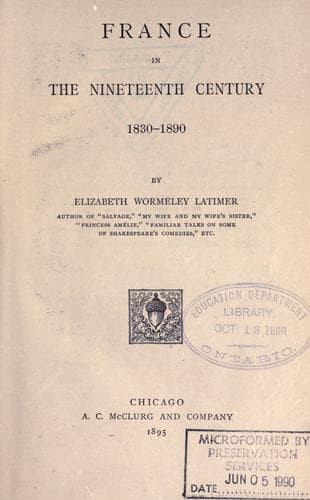
France in the Nineteenth CenturyLatimer, Elizabeth Wormeley
History
France in the Nineteenth Century
Latimer, Elizabeth Wormeley
France -- History -- 1789-1900
As soon as relations became "strained" between France and Germany,
according to the term used in diplomacy, the king of Prussia ordered
home all his subjects who had found employment in France, especially
those in Alsace and Lorraine.[1] Long before this, those provinces
had been overrun with photographers, pedlers, and travelling workmen,
commissioned to make themselves fully acquainted with the roads,
the by-paths, the resources of the villages, and the character
of the rural officials. In the case of France, however, though
all the reports concerning military stores looked well on paper,
the old guns mounted on the frontier fortresses were worthless,
and the organization of the army was so imperfect that scarcely
more than two hundred thousand troops could be sent to defend the
French frontier from Switzerland to Luxemburg; while Germany, with
an army that could be mobilized in eleven days, was ready by the
1st of August to pour five hundred thousand men across the Rhine.
The emperor placed great reliance on his _mitrailleuses_,--a new
engine of war that would fire a volley of musketry at once, but
which, though horribly murderous, has not proved of great value in
actual warfare. Towards the Rhine were hurried soldiers, recruits,
cannon, horses, artillery, ammunition, wagons full of biscuit and
all manner of munitions of war. The roads between Strasburg and
Belfort were blocked up, and in the disorder nobody seemed to know
what should be done. Every one was trying to get orders. The telegraph
lines were reserved for the Government. Quartermasters were roaming
about in search of their depots, colonels were looking for their
regiments, generals for their brigades or divisions. There were
loud outcries for salt, sugar, coffee, bacon, and bridles. Maps
of Germany as far as the shores of the Baltic were being issued
to soldiers who, alas! were never to pass their own frontier. But
while this was the situation near the seat of war, in other parts
of France the scene was different, especially in Brest and other
seaports. These towns were crowded with soldiers and sailors; the
streets were filled with half-drunken recruits bawling patriotic
sentiments in tipsy songs. And now, for the first time since the
Empire came into existence, might be heard the unaccustomed strains
of the "Marseillaise." It had been long suppressed in France; but
when war became imminent, it was encouraged for the purpose of
exciting military ardor.
[Footnote 1: Erckmann-Chatrian, La Plébiscite.]
Public-domain text, read in full here on John Shaqi.
Reviews
Reviews
No reviews yet
Be the first to share your thoughts on this work.
Elsewhere in the archive
Join the Discussion
Join the discussion
Sign in to leave a comment or review.
Sign InorCreate an account