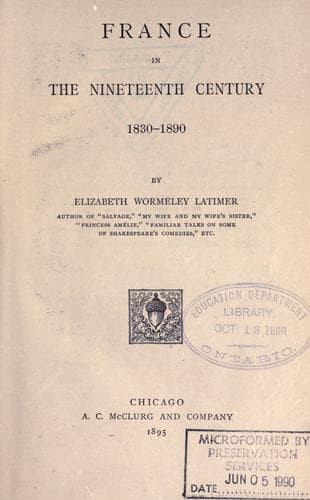
France in the Nineteenth CenturyLatimer, Elizabeth Wormeley
History
France in the Nineteenth Century
Latimer, Elizabeth Wormeley
France -- History -- 1789-1900
Every day in the provincial towns the war fever grew fiercer. The
bugle sounded incessantly in the streets of any place where there
were troops in garrison. Regiment followed regiment on its way
into Paris, changing quarters or marching to depots to receive
equipments. Orderlies galloped madly about, and heavy ammunition
wagons lumbered noisily over the pavements. Everybody shouted "A
Berlin," and took up the chorus of the "Marseillaise." The post-offices
and telegraph-offices were crowded with soldiers openly dictating
their messages to patient officials who put them into shape, and
it was said that nearly every telegram contained the words, "Please
send me..." Alas, poor fellows! it is probable that nothing sent
them in reply was ever received.[1]
[Footnote 1: I am indebted for much in this chapter to a private
journal.]
Parisians or residents in Paris all believed at that time in the
prestige of the French army; only here and there a German exile
muttered in his beard something about Sadowa.
On July 27 all Paris assembled on the Boulevards to see the Garde
Impériale take its departure for the frontier. This Imperial Guard
was a choice corps created by Napoleon III. at the outset of the
Crimean War. It was a force numbering nominally twenty thousand
infantry and three thousand cavalry. It was a very popular corps,
and the war with Germany was popular; consequently the march from
its barracks to the railroad station was one continued triumph.
At every halt the Parisians pressed into the ranks with gifts of
money, wine, and cigars. "Vive l'armée!" shouted the multitude.
"A Berlin!" responded the troops; and now and then, as the bands
struck up the "Marseillaise," the population and the troops burst
out in chorus with the solemn, spirit-stirring words.
At the head of this brilliant host rode Marshal Le Bœuf, who was
minister of war and military tutor to the Prince Imperial. After
the departure of the main body of the corps, large detachments
of cavalry and artillery which belonged to it were expected to
follow; but they remained behind in the provinces, because Lyons,
Marseilles, and Algeria, all centres of the revolutionary spirit,
could not, it was found, be left without armed protection. Therefore
only a portion of the crack corps of the French army went forward to
the frontier,--a fact never suspected by the public until events,
a few weeks later, made it known.
Public-domain text, read in full here on John Shaqi.
Reviews
Reviews
No reviews yet
Be the first to share your thoughts on this work.
Elsewhere in the archive
Join the Discussion
Join the discussion
Sign in to leave a comment or review.
Sign InorCreate an account