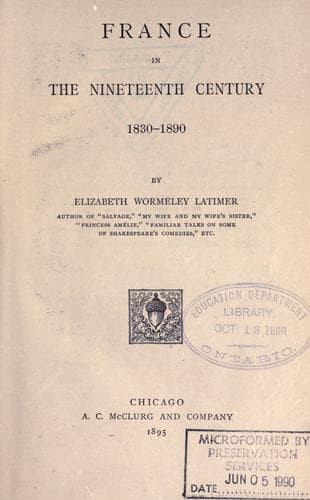
France in the Nineteenth CenturyLatimer, Elizabeth Wormeley
History
France in the Nineteenth Century
Latimer, Elizabeth Wormeley
France -- History -- 1789-1900
Paris was jubilant. The theatres especially became centres of patriotic
demonstrations. At the Grand Opera House, Auber's "Massaniello"
(called in France the "Muette de Portici") was announced. For many
years its performance had been interdicted under the Second Empire,
the story being one of heroic revolt. The time had come, however,
when its ardent patriotism entitled it to resuscitation. Faure,
the most remarkable baritone singer of the period, suddenly, at the
beginning of the second act, which opens with a chorus of fishermen
inciting each other to resist oppression, appeared upon the stage
bearing the French flag. The chorus ranged themselves to right
and left as he strode forward and waved the tricolor above the
footlights. The house broke into wild uproar, cheer after cheer
rose for the flag, for the singer, for France.
"The violence of the applause," says one who was present, "continued
until all were breathless; then a sudden silence preceded the great
event of the evening. In clear, firm tones, Faure launched forth the
first notes of the 'Marseillaise;' and as the first verse ended,
he bounded forward, and unfurling the flag to its full length and
breadth, he waved it high above his head as he electrified the
audience with the cry, 'Aux armes citoyens!' and subsequently, when
in the last verse he sank upon one knee, and folding the standard
to his heart, raised his eyes towards heaven, he drew all hearts
with him; tears flowed, hand grasped hand, and deeply solemn was
the intonation of the volunteer chorus following the call to arms!
"The month of July was drawing to a close when the emperor took his
departure for Metz, where he was to assume the post of generalissimo.
With him went gayly the young Prince Imperial, then fourteen years
old. Their starting-point was the small rustic summer-house in
the park of Saint-Cloud, the termination of a miniature branch
railroad connecting with the great lines of travel. There the father
and son parted from the empress, who removed the same day to the
Tuileries, where she administered the imperial government under
the title of empress-regent.
"It would have been injudicious for the emperor at this time to
risk a public departure from Paris. The Parisians were so full of
confidence and enthusiasm that he might have received an inconvenient
ovation in advance."
Public-domain text, read in full here on John Shaqi.
Reviews
Reviews
No reviews yet
Be the first to share your thoughts on this work.
Elsewhere in the archive
Join the Discussion
Join the discussion
Sign in to leave a comment or review.
Sign InorCreate an account