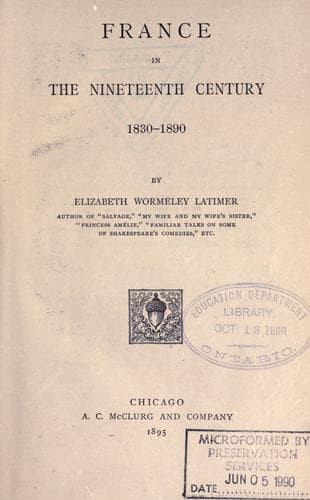
France in the Nineteenth CenturyLatimer, Elizabeth Wormeley
History
France in the Nineteenth Century
Latimer, Elizabeth Wormeley
France -- History -- 1789-1900
The first thing to be done was to bring provisions into the city.
Cattle, grain, salt, hay, preserved meats, in short, everything
edible that could be imagined, poured in so long as the railroads
remained open. All public buildings became storehouses, but affairs
were conducted with such recklessness and disorder that the live-stock
suffered terribly, and half the hay was wasted. As to troops, General
Vinoy arrived with twenty thousand soldiers, who had been stationed
between Belgium and Sedan. They had never fought the Pussians, but
were impatient of discipline and utterly demoralized. Stragglers
and fugitives from Sedan came in also, but these were still less
to be depended on. The National Guard had never enjoyed the favor
of the emperor, and had been suffered to fall to pieces. It was now
reorganized and armed as well as the Government was able. There was
a body of Mobiles who had been sent away from the army by Marshal
MacMahon because they were so insubordinate that he did not know
what to do with them. Ninety thousand Mobiles came up from the
Provinces before the gates of Paris closed,--excellent material for
soldiers but wholly uninstructed,--and finally about ten thousand
sailors arrived from Brest, who were kept in strict line by their
officers, and were the most reliable part garrison.
The male population of Paris remained in the city, almost to a
man, except those known to the police as thieves or ex-convicts,
who were all sent away. Women and children also were removed, if
their husbands and fathers could afford places of safety.
Around the city was a wall twelve yards high, forming a polygonal
inclosure. At each corner of the polygon was a bastion, in which
were stationed the big guns. The wall connecting the bastions is
called a curtain. The bastions protected the curtains, and were
themselves protected by sixteen detached forts, built on all the
eminences around Paris. The most celebrated of these forts lies to
the west of Paris, between it and Versailles, and is called Fort
Valérien It is erected on a steep hill long called Mont Calvaire,
from which is a magnificent view of the city. This and stony hill
for several centuries used to be ascended by pilgrims on their
knees; the mount, where once stood an altar of the Druids, became
a consecrated place before the Revolution.
Public-domain text, read in full here on John Shaqi.
Reviews
Reviews
No reviews yet
Be the first to share your thoughts on this work.
Elsewhere in the archive
Join the Discussion
Join the discussion
Sign in to leave a comment or review.
Sign InorCreate an account