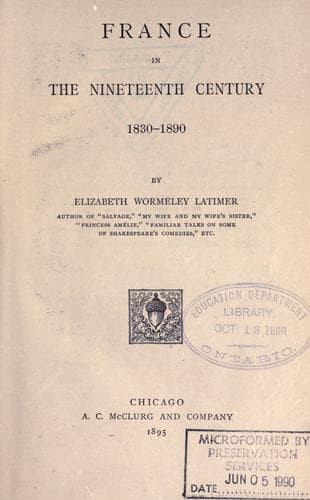
France in the Nineteenth CenturyLatimer, Elizabeth Wormeley
History
France in the Nineteenth Century
Latimer, Elizabeth Wormeley
France -- History -- 1789-1900
Louis Philippe, in 1841, had planned the fortifications of Paris,
but in his time they had been only partially constructed. Even
in 1870, as I have said, they were not complete. When the siege
became imminent, the first thing to be done was to put them in good
order; but for a week the working-men in Paris were so intoxicated
with the idea of having a republic that they could not be made to
do steady work upon anything. It was also considered necessary to
cut down all trees and to destroy all villages between the forts
and the walls of the city, so that they might afford no shelter
to the Prussians. The poor inhabitants of these villages flocked
into Paris, bringing with them carts piled with their household
goods, their wives and children peeping out aghast between the
chairs and beds. The beautiful trees in the Bois de Boulogne were
cut down; the deer and the swans and other wild fowl on the lakes
(long the pets of the Parisian holiday makers) were shot by parties
of Mobiles sent out for that purpose.
No military man believed that Paris, defended by uncompleted
fortifications, could withstand a direct attack from the Prussians;
no one dreamed of a blockade, for it was thought that it would
take a million and a quarter of men to invest the city, and the
Prussians were known not to have that number for the purpose. The
idea was that the enemy would choose some point, would attack it
with all his forces, would lose probably thirty thousand men, and
would take the city. But Bismarck and King William and Von Moltke
had no idea of losing thirty thousand men. They were certain that
there would be risings and disturbances in Paris. They believed that
their forces might even be called in to save respectable Parisians
from the outrages of the Reds. They knew that rural France, having
little love for Paris or the Republic, was not likely to accept
the Government formed without its own consent, nor march to the
assistance of the capital. Even should the provincial population
bestir itself, the troops it could send would be only raw levies,
and there was no great leader to animate or to direct popular
enthusiasm.
It was quite true that the respectable classes in Paris had as
much to fear from the Reds as from the Prussians. The mob of Paris
was wild for a commune.
It is not always known what is meant by a commune, and I may be
pardoned if I pause to define it here.
Public-domain text, read in full here on John Shaqi.
Reviews
Reviews
No reviews yet
Be the first to share your thoughts on this work.
Elsewhere in the archive
Join the Discussion
Join the discussion
Sign in to leave a comment or review.
Sign InorCreate an account