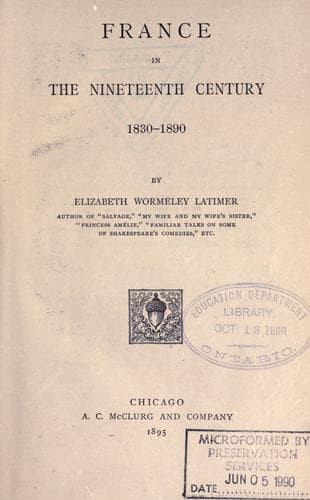
France in the Nineteenth CenturyLatimer, Elizabeth Wormeley
History
France in the Nineteenth Century
Latimer, Elizabeth Wormeley
France -- History -- 1789-1900
"I was," says Jules Favre, "at the Château de Ferrières by eleven
A. M., but Count Bismarck did not leave the king's apartments before
twelve. I then gathered from him the conditions that he demanded
for an armistice. They were written in German, and he read them
over to me. He desired to occupy, as a guarantee, Strasburg, Toul,
and Phalsbourg;[1] and as I had the day before named Paris as the
place for the meeting of the Assembly, he wished in that case to
have possession of some fort commanding the city. He named Fort
Valérien. Here I interrupted him. 'You had better ask for Paris at
once,' I said. 'How can a French Assembly be expected to deliberate
when covered by your guns? I hardly know whether I dare to inform
my Government that you have made such a proposal.' Tours was then
named as a place for the Assembly. 'But,' said Bismarck, 'Strasburg
must be surrendered. It is about to fall into our hands. All I
ask is that the garrison shall constitute themselves prisoners
of war.' At this I could restrain myself no longer. I sprang to
my feet and said: 'Count Bismarck, you forget you are speaking
to a Frenchman! To sacrifice an heroic garrison which has won our
admiration and that of the whole world, would be an act of cowardice.
Nor will I even promise to mention that you ever made such a demand.'
He answered that he had not meant to wound my feelings, he was
acting in conformity with the laws of war; but he would see what
the king said about the matter. He returned in a quarter of an
hour, and said that his master accepted my proposal as to Tours,
but insisted on the surrender of the garrison of Strasburg."
[Footnote 1: Places still holding out against the Germans.]
At this, the negotiation was broken off, Jules Favre concluding
by saying that "the inhabitants of Paris were resolved on making
any sacrifices, and that their heroism might change the current
of events."
The publication of this account of the interview with Bismarck
produced through Paris a shiver of indignation. For a moment all
parties were united, the very Reds crying out that there must be
no more parties, only Frenchmen; and a slight success in a skirmish
in one of the suburbs of Paris roused enthusiasm to its height in
a few hours.
The National Guard now did duty as police, and was also placed
on guard on the ramparts. Each man received thirty sous a day.
The Guard was divided into the Old Battalions and the New. The
Old Battalions were composed almost entirely of gentlemen and
_bourgeois_, who returned their pay to the Government; the New
Battalions, which were fresh levies of working-men, preferred in
general a franc and a half a day for doing nothing, to higher wages
for making shoes, guns, and uniforms. In vain the Government put
forth proclamations assuring the people that the man who made a
chassepot rifle was more of a patriot than he who carried one.
Public-domain text, read in full here on John Shaqi.
Reviews
Reviews
No reviews yet
Be the first to share your thoughts on this work.
Elsewhere in the archive
Join the Discussion
Join the discussion
Sign in to leave a comment or review.
Sign InorCreate an account