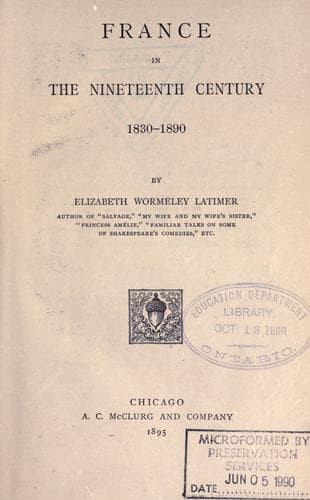
France in the Nineteenth CenturyLatimer, Elizabeth Wormeley
History
France in the Nineteenth Century
Latimer, Elizabeth Wormeley
France -- History -- 1789-1900
Till September 19 the railways continued to run. Then the fifty-one
gates of Paris were closed, the railroad entrances were walled
up, and the following notice appeared upon the walls:--
"Citizens! The last lines which connected Paris with France and
Europe were cut yesterday evening. Paris is left to herself. She
has now only her own courage and her own resources to rely on.
Europe, which has received so much enlightenment from this great
city, and has always felt a certain jealousy of her glory, now
abandons her. But Paris, we are persuaded, will prove that she has
not ceased to be the most solid rampart of French independence."
To _hold out_ was the determination of all classes; but the very
next day the Reds put forth a manifesto demanding a commune, the
dismissal of the police, the sequestration of the property of all
rich or influential men, and a public declaration that the king of
Prussia would not be treated with so long as his armies occupied
one foot of French soil. "Nothing less than these things," said
the document, "will satisfy the people."
Here we see the usual assumption of the Parisian Communists that
they are "the people." They have always assumed that thirty-two
millions of Frenchmen outside the walls of Paris counted for nothing.
As the Prussian armies passed to the southward of Paris to take
possession of Versailles, an attack, authorized by General Trochu
and by General Ducrot (who had escaped from Sedan), was made upon
the German columns. The Zouaves, who had come back to Paris under
General Vinoy, demoralized by the disasters of their comrades, were
the first to break and run. The poor little Mobiles stood firm
and did their duty.
The official report said: "Some of our soldiers took to flight
with regrettable haste,"--a phrase which became a great joke among
the Parisians.
That night the Reds breathed fire and fury against the Government,
"and the respectable part of Paris," says M. de Sarcey, the great
dramatic critic, "saw themselves between two dangers. It would
be hard to say which of them they dreaded most. They hated the
Prussians very much, but they feared the men of Belleville more."
Meantime Jules Favre, who had been appointed Minister for Foreign
Affairs, had procured a safe-conduct from the Prussians, and had
gone out to see Count Bismarck and King William, who had their
headquarters at Baron Rothschild's beautiful country seat of Ferrières.
His object was to obtain an armistice, that a National Assembly
might be convoked which would consider the terms of peace with
the Prussians.
The Chancellor of North Germany declared that he did not recognize
the Committee of Defence, represented by Julus Favre, as a legitimate
government of France competent to offer or to consider terms of
peace. He treated M. Favre with the greatest haughtiness, utterly
refusing any armistice, but at the close of their first interview
he consented to see him again the next day.
Public-domain text, read in full here on John Shaqi.
Reviews
Reviews
No reviews yet
Be the first to share your thoughts on this work.
Elsewhere in the archive
Join the Discussion
Join the discussion
Sign in to leave a comment or review.
Sign InorCreate an account