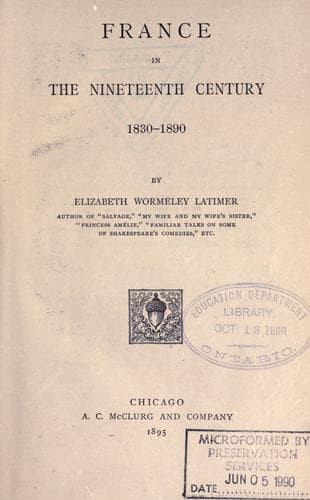
France in the Nineteenth CenturyLatimer, Elizabeth Wormeley
History
France in the Nineteenth Century
Latimer, Elizabeth Wormeley
France -- History -- 1789-1900
The weather changed soon after the family had settled at Goritz.
The keen winter winds blew down from the snow mountains, but the
king did not give up his daily sport. One afternoon, after a cold
morning spent upon the hills, he was seized at evening service
in the chapel with violent spasms. These passed off, but on his
joining his family later, its members were struck by the change
in his appearance. In a few hours he seemed to have aged years.
At night he grew so ill that extreme unction was administered to
him. It was an attack of cholera. When dying, he blessed his little
grandchildren, the boy and girl, who, notwithstanding the nature of
his illness, were brought to him. "God preserve you, dear children,"
he said. "Walk in paths of righteousness. Don't forget me.... Pray
for me sometimes."
He died Nov. 6, 1836, just one week after Louis Napoleon made his
first attempt to have himself proclaimed Emperor of the French,
at Strasburg.
He was buried near Goritz, in a chapel belonging to the Capuchin
Friars. In another chapel belonging to the same lowly order in
Vienna, had been buried four years before, another claimant to the
French throne, the Duc de Reichstadt, the only son of Napoleon.
On the coffin of the ex-king was inscribed,--
"Here lieth the High, the Potent, and most Excellent Prince, Charles
Tenth of that name; by the Grace of God King of France and of Navarre.
Died at Goritz, Nov. 6, 1836, aged 79 years and 28 days."
All the courts of Europe put on mourning for him, that of France
excepted. The latter part of his life, with its reverses and
humiliations, he considered an expiation, not for his political
errors, but for the sins of his youth.
As he drew near his end, his yearnings after his lost country increased
more and more. He firmly believed that the day would come when his
family would be restored to the throne of France, but he believed
that it would not be by conspiracy or revolt, but by the direct
interposition of God. That time did almost come in 1871, after
the Commune.
CHAPTER II.
LOUIS PHILIPPE AND HIS FAMILY.
Louis Philippe, after accepting the lieutenant-generalship of the
kingdom, which would have made him regent under Henri V., found
himself raised by the will of the people--or rather, as some said,
by the will of the _bourgeoisie_--to the French throne. He reigned,
not by "right divine," but as the chosen ruler of his countrymen,--to
mark which distinction he took the title of King of the French,
instead of King of France, which had been borne by his predecessors.
It is hardly necessary for us to enter largely into French politics
at this period. The government was supposed to be a monarchy planted
upon republican institutions. The law recognized no hereditary
aristocracy. There was a chamber of peers, but the peers bore no
titles, and were chosen only for life. The dukes, marquises, and
counts of the old régime retained their titles only by courtesy.
Public-domain text, read in full here on John Shaqi.
Reviews
Reviews
No reviews yet
Be the first to share your thoughts on this work.
Join the Discussion
Join the discussion
Sign in to leave a comment or review.
Sign InorCreate an account