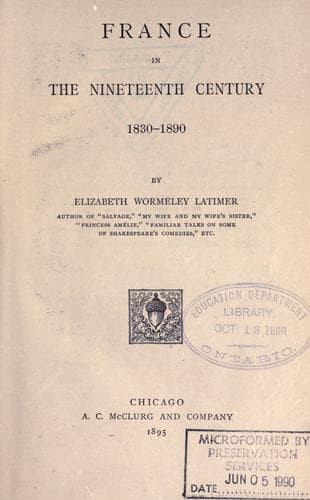
France in the Nineteenth CenturyLatimer, Elizabeth Wormeley
History
France in the Nineteenth Century
Latimer, Elizabeth Wormeley
France -- History -- 1789-1900
"That a vast army which had given ample proof of military worth in
the two great battles of Gravelotte, and which moreover possessed
the support of the most important stronghold in France, should have
permitted a scarcely superior enemy to hem it in and to detain
it for weeks, making no earnest attempt to escape, and finally, at
the conqueror's bidding, should have laid down its arms without
striking a blow, would before the event," says an English military
authority, "have seemed impossible. It set the investing force
free to crush the new-made Army of the Loire, and it occurred in
the nick of time to prevent the raising of the siege of Paris,
which the Germans had in contemplation."
Smaller places held out nobly,--Phalsbourg in Alsace, and Thionville
and Toul, but above all Belfort. Garibaldi was there with a considerable
body of Italians and a contingent of two hundred well-armed Greeks.
There was great jealousy of Garibaldi and his Italians in the Southern
army, and their outrageous conduct towards priests and churches
set against them the women and the peasantry.
Belfort never surrendered. But the army under Bourbaki, called
the Army of the East, nearly a hundred thousand strong, suffered
horribly in the latter days of the struggle. It was not included in
the armistice made at the close of January, 1871, between Bismarck
and Jules Favre, for Favre was in total ignorance of its position.
Bourbaki attempted suicide. His soldiers, shoeless, tentless, and
unprovided with provisions, pushed into the defiles of the Jura
in the depths of one of the coldest winters ever known in Europe,
hoping to escape into Switzerland. Eighty thousand men made their
way over the mountains; fifteen thousand were made prisoners. A
few escaped to their homes. A correspondent who saw them after
they reached safety, said,--
"In all of them, pinched features and a slouching gait told of
gnawing hunger, while their hollow voices told of nights spent
on snow and frozen ground. Some had tied bits of wood under their
bare feet to keep them from the stones. For weeks none had washed,
or changed their clothes. Their hands were black as Africans'. For
three days neither food nor fodder had been served out to them,
and before that they had only got one four-pound loaf among eight
men."
While men were thus suffering in the mountains, an event of the
greatest political importance was taking place at Versailles. On
January 19, a week before the capitulation of Paris, the king of
Prussia received a deputation from the German Reichstag, offering
him the imperial crown of Germany.
Public-domain text, read in full here on John Shaqi.
Reviews
Reviews
No reviews yet
Be the first to share your thoughts on this work.
Elsewhere in the archive
Join the Discussion
Join the discussion
Sign in to leave a comment or review.
Sign InorCreate an account