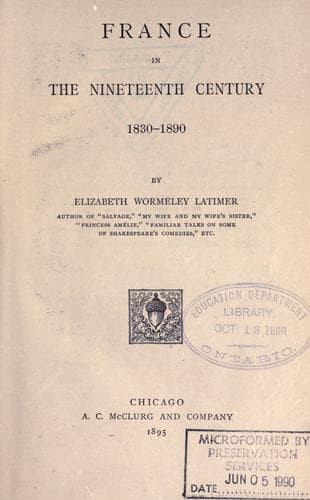
France in the Nineteenth CenturyLatimer, Elizabeth Wormeley
History
France in the Nineteenth Century
Latimer, Elizabeth Wormeley
France -- History -- 1789-1900
The Federal States of the German Empire up to the close of the
last century were three hundred and sixty; many of these were only
free cities or extremely small duchies or principalities. There
was a German emperor and a German Diet. The latter met always at
Frankfort. The emperor might be of any family or of any religion.
His successor was elected during his lifetime, to be ready in case
of accident, and was called King of the Romans. The emperor was
at first chosen by the princes at large, but in process of time
the choice was made over to nine princes, called electors. After
1438, all emperors of Germany were of the house of Hapsburg, the
royal family of Austria. This was not law, but custom. In the days
of Napoleon I. the old German Empire was broken up. The title of
Emperor of Germany was discontinued, though he who would have borne
it still held an imperial title as Emperor of Austria. The small
German princes were mediatized; that is, pensioned, and reduced
from sovereign princes to the condition of mere nobles. In place
of three hundred and sixty States there remained thirty-six States,
composing the German Confederation. A new German Federal Constitution
was formed; the States agreed to defend one another, to do nothing
to injure one another, and to abstain from making war upon one
another. There were practically seventeen votes in the Diet, some
of the larger States having several, and many of the smaller States
uniting in the possession of one.
This Constitution also was swept away in 1866, after the brilliant
campaign of Sadowa.
The great desire of patriotic Germans was to consolidate Germany,--to
make her strong; and while Prussia, assisted by all the North German
States and by Bavaria, Baden, Würtemberg, and Darmstadt, was fighting
France, a new Federal, Constitution was formed.
The king of Prussia was chosen German emperor, and the imperial
crown was to be hereditary in his family. There is a Diet, or Federal
Congress, composed of two Houses, the Upper House being limited
to sovereign princes or their representatives, the other, called
the Reichstag, being really the governing power of the nation.
Each State is entitled also to its own legislature.
In the Reichstag, Prussia has nearly two thirds of the votes; and
its power is much greater than that of our Congress at Washington.
The emperor can veto its decisions only when they affect changes
in the constitution. The Diet can dethrone any emperor if he is
considered incapable of governing, or supposed to be dangerous
to the Fatherland.
Practically the power of Prussia seems boundless in the federation;
she enforces her military system on all Germany, and the smaller
States submit to her, for the sake of strength and unity.
Public-domain text, read in full here on John Shaqi.
Reviews
Reviews
No reviews yet
Be the first to share your thoughts on this work.
Elsewhere in the archive
Join the Discussion
Join the discussion
Sign in to leave a comment or review.
Sign InorCreate an account