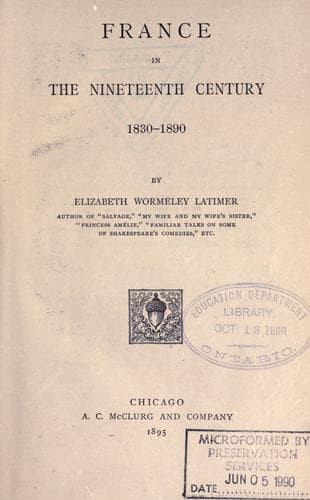
France in the Nineteenth CenturyLatimer, Elizabeth Wormeley
History
France in the Nineteenth Century
Latimer, Elizabeth Wormeley
France -- History -- 1789-1900
On Jan. 18, 1871, a deputation of fifty members of the Reichstag
came to the king of Prussia's headquarters at Versailles to implore
him to accept the imperial crown of Germany. The world's attention
was engrossed by the campaign which was then drawing to a close, and
the offering of the imperial crown to the Prussian sovereign formed
only a dramatic episode in the history of the war. Fortunately, as
the deputies passed Paris, shivering in their furs, while transported
in carriages of all descriptions, the Parisians made no sortie to
intercept them, and they reached Versailles in safety.
The French seemed perfectly indifferent on the occasion. "Do as
you like," seemed to be the feeling. "Have an empire if you think
proper. It is no concern of ours. We are glad to have got rid of
our own."
The day on which the deputies offered their great gift to King
William was clear and bright. Before the prefecture at Versailles
was planted the Prussian royal standard,--a black cross on a ground
of gold and purple. Round the gateway stood all the Prussian soldiers
who were off duty, waiting to see the deputies pass in. There was
no music, but shots boomed from Paris from time to time. There
was to be thenceforward one Germany, and one flag for the land
of so many princes, who all waived their claims in favor of the
greatest among them,--he who now stood conqueror in a foreign land.
The chief room of the prefecture was filled with men in bright
uniforms, with helmets, ribbons, and decorations of all kinds. The
king stood near the fireplace, surrounded by princes and generals.
The president of the North German Confederation appointed to address
him had once before, in 1849, offered the imperial crown to a Prussian
king, who had declined it. Since then events had ripened. This time
the king accepted what his countrymen desired he should receive
from them. But he declined to assume the title of emperor until
the South German people should express their acquiescence, as the
South German princes had already done.
We may contrast the conduct of the Prussian king with the unwisdom
of the French emperor. Both Napoleon III. and the Emperor William
governed as autocrats; but with what different men they surrounded
themselves, and how differently they were served in their hour of
need! Yet Napoleon III. was lavish of rewards to his adherents,
while the Emperor William was, to an excessive degree, chary of
recompense. He seemed to feel that each man owed his all to his
kaiser and his country, and that when he had given all, he could
only say, in the words of Scripture: "I have but done that it was
my duty to do."
Public-domain text, read in full here on John Shaqi.
Reviews
Reviews
No reviews yet
Be the first to share your thoughts on this work.
Elsewhere in the archive
Join the Discussion
Join the discussion
Sign in to leave a comment or review.
Sign InorCreate an account