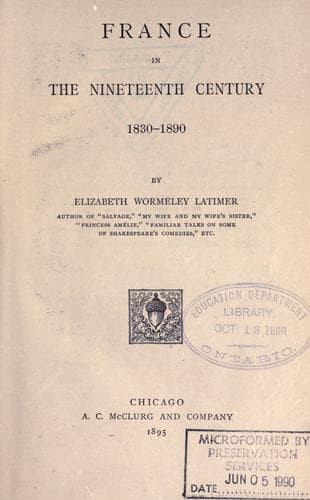
France in the Nineteenth CenturyLatimer, Elizabeth Wormeley
History
France in the Nineteenth Century
Latimer, Elizabeth Wormeley
France -- History -- 1789-1900
Seeing that news of what was passing would most certainly be brought
in from the outposts, it seemed best that the French Minister for
Foreign Affairs should start at once for the interview. There was
in the courtyard a _coupé_ with a handsome horse, once belonging
to Napoleon III., and driven by one of his former coachmen. Jules
Favre at once got into it, with his son-in-law and M. d'Hérisson.
They passed with some difficulty through the Bois de Boulogne, the
roads having been torn up and trees felled in every direction. On
reaching a French outpost Jules Favre, afraid of being recognized,
concealed his face. Their only means of crossing the Seine at Sèvres
was to take a small boat which had served General Burnside a few days
before. But the Prussians had been making a target of it ever since,
and it was riddled with bullets. Having bailed it out, however,
with an old saucepan, they stuffed their handkerchiefs into the
worst leaks, and crossed the Seine in safety.
In a miserable old carriage, attended by a Prussian escort, Jules
Favre was borne away to his terrible interview with Bismarck, leaving
d'Hérisson behind. Favre did not come back for many hours. His
first words to his aide-de-camp were: "Oh, my dear fellow, I was
wrong to go without you. What have I not suffered?"
He had been taken at once to a very modest house in Versailles,
where Bismarck had his quarters. After the first salutations Jules
Favre said that he came to renew the negotiations broken off at
Ferrières. Here Bismarck interrupted him, saying: "The situation
is changed. If you are still going to say, 'Not an inch, not a
stone,' as you did at Ferrières, we may break off at once. My time
is valuable, and yours too." Then suddenly he added: "Your hair has
grown much grayer than it was at Ferrières." Jules Favre replied that
that was due to anxiety and the cares of government. The chancellor
answered that the Government of Paris had put off a long time asking
for peace, and that he had been on the eve of making an arrangement
with an envoy from Napoleon III. He then explained that it would
be easy for him to bring back the emperor and to force France to
receive him; that Napoleon could collect an army of a hundred thousand
men among the French prisoners of war in Germany, etc.; and he
added: "After all, why should I treat with you? Why should I give
your irregular Republic an appearance of legality by signing an
armistice with its representative? What are you but rebels? Your
emperor if he came back would have the right to shoot every one
of you."
"But if he came back," cried Jules Favre, "all would be civil war
and anarchy."
"Are you so sure of that?" said the chancellor. "Anyhow, a civil
war in France could not affect Germany."
"But, M. le Comte, are you not afraid of reducing us to despair,
of exasperating our resistance?"
Public-domain text, read in full here on John Shaqi.
Reviews
Reviews
No reviews yet
Be the first to share your thoughts on this work.
Elsewhere in the archive
Join the Discussion
Join the discussion
Sign in to leave a comment or review.
Sign InorCreate an account