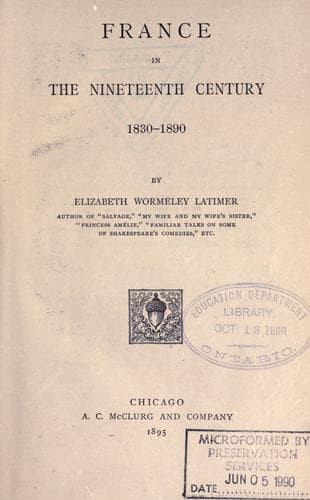
France in the Nineteenth CenturyLatimer, Elizabeth Wormeley
History
France in the Nineteenth Century
Latimer, Elizabeth Wormeley
France -- History -- 1789-1900
"Your resistance!" cried Bismarck. "Are you proud of your resistance?
If General Trochu were a German, I would have him shot this evening.
You have no right, for the sake of mere military vainglory, to
risk the lives of two millions of people. The railroad tracks have
been torn up, and if we cannot lay them down again in two days, we
know that a hundred thousand people in Paris will die of famine.
Don't talk of resistance, it is criminal."
Jules Favre, put entirely out of countenance by Bismarck's tone,
merely insisted that in pity to France there should be no question
of subjecting her to the ignominy of being again made over to her
deposed emperor. Before parting, Bismarck requested him to write
down such conditions of peace as seemed to him reasonable, in order
that they might discuss them the next day.[1]
[Footnote 1: My copy of d'Hérisson's book has a pencil note at
this place, written by a friend then at Versailles: "Bismarck rode
after Jules Favre when he set out on his return, and thrust into
his carriage an enormous sausage."]
When that day came, the chancellor, having had interviews with
his sovereign and Von Moltke, submitted his own propositions. They
were seven in number:--
I. An armistice for twenty-one days.
II. Disarmament of the French army, to remain in Paris as prisoners
of war.
III. The soldiers to give up arms and banners; officers to keep
their swords.
IV. The armistice to extend all over France.
V. Paris to pay indemnity, and give up its forts to the Prussians.
VI. The Germans not to enter Paris during the armistice.
VII. Elections to be held throughout France for a National Assembly
charged to consider conditions of peace.
Some slight modifications were made in these hard terms, which were
signed Jan. 28, 1871.
As aide-de-camp and secretary to the French minister, d'Hérisson
was present at all the interviews between Bismarck and his principal.
When the terms, proposed by Germany were reported by Jules Favre
to the Committee of Defence, they were thought less severe than
had been feared.
The next morning Favre and d'Hérisson were at Versailles by dawn.
Bismarck, who was an early riser, soon appeared, and took the minister
and his aide-de-camp to his study. There the two men talked, and
the secretary took notes of the conversation.
Public-domain text, read in full here on John Shaqi.
Reviews
Reviews
No reviews yet
Be the first to share your thoughts on this work.
Elsewhere in the archive
Join the Discussion
Join the discussion
Sign in to leave a comment or review.
Sign InorCreate an account