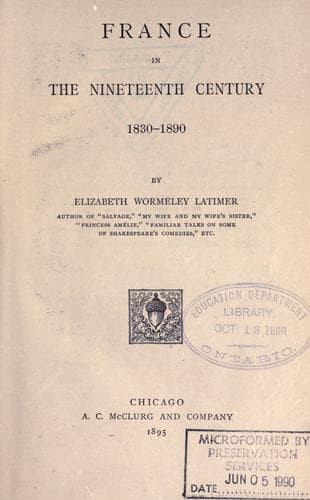
France in the Nineteenth CenturyLatimer, Elizabeth Wormeley
History
France in the Nineteenth Century
Latimer, Elizabeth Wormeley
France -- History -- 1789-1900
It was necessary, however, that a French general should come out
to Versailles the next day and confer with Count von Moltke with
regard to some military details. The old general who was chosen
for that service was furious at the appointment, and behaved with
such rudeness that Bismarck requested that a man more courteous
might replace him.
In the course of the conversation Bismarck, who was always breaking
off upon side topics, replied to an observation made by Jules Favre
about the love of France for a republic, by saying: "Are you so
sure of that?--for I don't think so. Before treating with you, we
naturally made it our business to obtain good information as to
the state of public feeling in your country; and notwithstanding
this unhappy war, which was forced by France upon Napoleon III.,
and notwithstanding the disasters of your armies, nothing would be
easier, believe me, than to re-establish the emperor. I will not
say that his restoration would have been hailed by acclamations
in Paris, but it would have been submitted to by the country. A
_plébiscite_ would have done the rest."
Jules Favre protested. "Oh, you will become more inclined to monarchy
as you grow older," cried the chancellor. "Look at me. I began
my public life by being a liberal; and now, by force of reason,
by the teachings of experience, and by an increased knowledge of
mankind, I have learned, loving my country, wishing her good and her
greatness, to become a conservative,--an upholder of authority. My
emperor converted me. My gratitude to him, my respectful affection,
date from the far-off time when he alone supported me. If I am to-day
the man you see me, if I have rendered any service to my country, I
owe it all, as I am pleased to acknowledge, to the emperor."
That night, as Jules Favre was returning to Paris to obtain from
his colleagues the ratification of the armistice, Bismarck proposed
that firing should cease at midnight. Jules Favre assented, but
asked as a courtesy that Paris might fire the last shot.
That night the terms of capitulation were signed by all the members
of the Committee of Defence. It is strange how the baptismal name
of Jules predominated among them,--Jules Favre, Jules Ferry, Jules
Simon, Jules Trochu. Trochu, however, did not sign, having resigned
his post that he might not be called upon to do so.
A few changes in the articles as at first drawn up were made. The
Prussians did not insist, as Bismarck had done at first, that the
cannon in the bastions should be hurled down, and regiments were
permitted to retain their colors, though Von Moltke objected strongly
to such concessions. They were granted, however, by the emperor,
when the matter was referred to him, but in words more insulting
than a refusal. "Tell the envoy of the French Government," he said,
"that we have trophies enough and standards enough taken from French
armies, and have no need of those of the army of Paris."
Public-domain text, read in full here on John Shaqi.
Reviews
Reviews
No reviews yet
Be the first to share your thoughts on this work.
Elsewhere in the archive
Join the Discussion
Join the discussion
Sign in to leave a comment or review.
Sign InorCreate an account