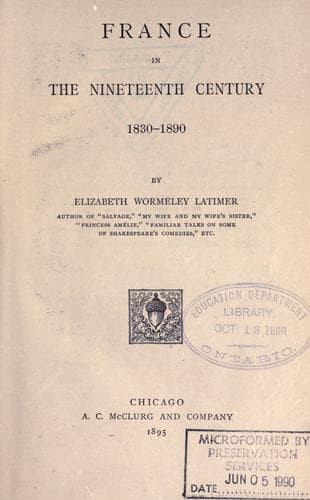
France in the Nineteenth CenturyLatimer, Elizabeth Wormeley
History
France in the Nineteenth Century
Latimer, Elizabeth Wormeley
France -- History -- 1789-1900
They talked of hunting. The chancellor related anecdotes of his
own prowess, and by the time they returned to Jules Favre, the
French aide-de-camp and the Prussian prime minister were on the
best terms with each other. But before long the chancellor gave a
specimen of the violence of his displeasure. "Three times," says
d'Hérisson, "I saw him angry,--once _à propos_ of Garibaldi; once
when speaking of the resistance of St. Quentin, an unwalled town,
which he said should have submitted at once; and once it was my
own fault."
On the table stood a saucer with three choice cigars. The chancellor
took it up and offered it to Jules Favre, who replied that he never
smoked; "There you are wrong," said Bismarck; "when a conversation
is about to take place which may lead to differences of opinion,
it is better to smoke. The cigar between a man's lips, which he
must not let fall, controls his physical impatience. It soothes him
imperceptibly. He grows more conciliatory. He is more disposed to
make concessions. And diplomacy is made up of reciprocal concessions.
You who don't smoke have one advantage over me,--you are more on
the alert. But I have an advantage over you,--you will be more
likely than I shall be to lose your self control and give way to
sudden impressions."
The negotiation was resumed very quietly. With astonishing frankness
the chancellor said simply and plainly what he wanted. He went straight
to his point, bewildering Jules Favre, a lawyer by profession, who
was accustomed to diplomatic circumlocutions, and was not prepared
for such imperious openness.
The chancellor spoke French admirably, "making use," says d'Hérisson
"of strong and choice expressions, and never seeming at a loss
for a word." But when the subject of Garibaldi and his army came
up, his eyes began to flash, and he seemed to curb himself with
difficulty. "I intend," he said, "to leave him and his followers
out of the armistice. He is not one of your own people. You can
very well leave him to me. Our army opposed to him is about equal
to his. Let them fight it out between them." Jules Favre replied
that this was impossible; for though France had not asked Garibaldi
for his services, and had in the first instance refused them,
circumstances had made him general-in-chief of a large _corps d'armée_
composed almost entirely of Frenchmen, and to abandon him would be
indefensible. Then the anger of the chancellor blazed forth against
Garibaldi. "I want to parade him through the streets of Berlin,"
he cried, "with a placard on his back: 'This is Gratitude!'"
Here d'Hérisson interrupted his burst of anger by picking up the
saucer from the table and holding it to his breast as beggars do
at the church-doors. The chancellor caught his idea after a moment.
He laughed, and Garibaldi, with his _corps d'armée_, was included
in the armistice.
Public-domain text, read in full here on John Shaqi.
Reviews
Reviews
No reviews yet
Be the first to share your thoughts on this work.
Elsewhere in the archive
Join the Discussion
Join the discussion
Sign in to leave a comment or review.
Sign InorCreate an account