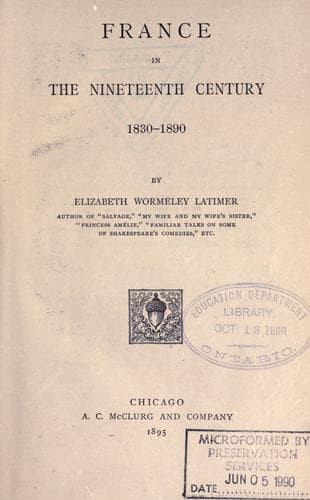
France in the Nineteenth CenturyLatimer, Elizabeth Wormeley
History
France in the Nineteenth Century
Latimer, Elizabeth Wormeley
France -- History -- 1789-1900
In vain the Government put forth proclamations calling on all good
citizens, and on the Old National Guard, to put down insurrection
and maintain order and the Republic. The Old Battalions of the
National Guard, about twenty thousand strong, had been composed
chiefly of tradesmen and gentlemen; these, as soon as the siege was
over, had for the most part left the city. Bismarck's proposition
to Jules Favre had been to leave the Old National Guard its arms,
that it might preserve order, but to take advantage of the occasion
to disarm the New Battalions. As we have seen, all were permitted
to retain their arms; but the chancellor told Jules Favre he would
live to repent having obtained the concession.
The friends of order, in spite of the Government's proclamations,
could with difficulty be roused to action. There were two parties
in Paris,--the Passives, and the Actives; and the latter party
increased in strength from day to day. Indeed, it was hard for
peaceful citizens to know under whom they were to range themselves.
The Government had left the city. One or two of its members were
still in Paris, but the rest had rushed off to Versailles, protected
by an army forty thousand strong, under General Vinoy.
A species of Government had, however, formed itself by the morning
of March 19 at the Hôtel-de-Ville. It called itself the Central
Committee of the National Guard, and issued proclamations on _white_
paper (white paper being reserved in Paris for proclamations of the
Government). It called upon all citizens in their sections at once
to elect a commune. This proclamation was signed by twenty citizens,
only one of whom, M. Assy, had ever been heard of in Paris. Some
months before, he had headed a strike, killed a policeman, and had
been condemned to the galleys for murder. The men who thus constituted
themselves a Government, were all members of the International,--that
secret association, formed in all countries, for the abolition of
property and patriotism, religion and the family, rulers, armies,
upper classes, and every species of refinement. Another proclamation
decreed that the people of Paris, whether it pleased them or not,
must on Wednesday, March 22, elect a commune.
In a former chapter I have tried to explain the nature of a commune.
Victor Hugo wrote his opinion of it, when the idea of a commune
was first started, after the fall of Louis Philippe in 1848. His
words read like a prophecy:--
Public-domain text, read in full here on John Shaqi.
Reviews
Reviews
No reviews yet
Be the first to share your thoughts on this work.
Elsewhere in the archive
Join the Discussion
Join the discussion
Sign in to leave a comment or review.
Sign InorCreate an account