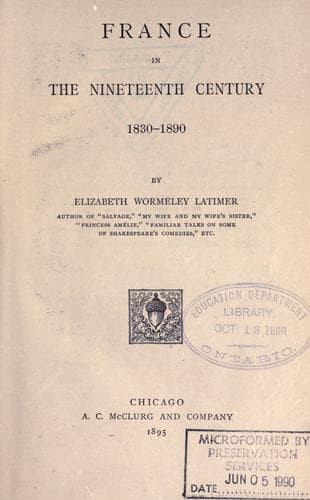
France in the Nineteenth CenturyLatimer, Elizabeth Wormeley
History
France in the Nineteenth Century
Latimer, Elizabeth Wormeley
France -- History -- 1789-1900
"It would tear down the tricolor, and set up the red flag of
destruction; it would make penny-pieces out of the Column of the
Place Vendôme; it would hurl down the statue of Napoleon, and set
up that of Marat in its place; it would suppress the Académie,
the École Polytechnique, and the Legion of Honor. To the grand
motto of 'Liberty, Equality, and Fraternity,' it would add the
words, 'or death.' It would bring about a general bankruptcy. It
would ruin the rich without enriching the poor. It would destroy
labor, which gives each of us his bread. It would abolish property,
and break up the family. It would march about with the heads of the
proscribed on pikes, fill the prisons with the suspected, and empty
them by massacre. It would convert France into a country of gloom. It
would destroy liberty, stifle the arts, silence thought, and deny
God. It would supply work for two things fatal to prosperity,--the
press that prints assignats, and the guillotine. In a word, it
would do in cold blood what the men of 1793 did in the ravings
of fever; and after the great horrors which our fathers saw, we
should have the horrible in every form that is low and base."
The party of the Commune has been divided into three classes,--the
rascals, the dupes, and the enthusiasts. The latter in the last
hours of the Commune (which lasted seventy-three days) put forth
in a manifesto their theory of government; to wit, that every city
in France should have absolute power to govern itself, should levy
its own taxes, make its own laws, provide its own soldiers, see to
its own schools, elect its own judges, and make within its corporate
limits whatever changes of government it pleased. These Communistic
cities were to be federated into a Republic. It was not clear how
those Frenchmen were to be governed who did not live in cities;
possibly each city was to have territory attached to it, as in
Italy in the Middle Ages.
The weather during March of the year 1871 was very fine, and fine
weather is always favorable to disturbances and revolutions.
The very few men of note still left in Paris desirous of putting
an end to disorder without the shedding of blood, proposed to go
out to Versailles and negotiate with M. Thiers, the provisional
president, and the members of his Government. They were the twelve
deputies of the Department of the Seine, in which Paris is situated,
headed by Louis Blanc, and the _maires_, with their assistants, from
the twenty arrondissements. They proposed to urge on the Government
of Versailles the policy of giving the Parisians the right to elect
what in England would be called a Lord Mayor, and likewise a city
council; also to give the National Guard the right to elect its
officers.
Public-domain text, read in full here on John Shaqi.
Reviews
Reviews
No reviews yet
Be the first to share your thoughts on this work.
Elsewhere in the archive
Join the Discussion
Join the discussion
Sign in to leave a comment or review.
Sign InorCreate an account