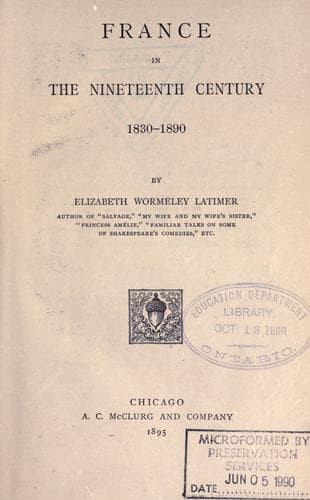
France in the Nineteenth CenturyLatimer, Elizabeth Wormeley
History
France in the Nineteenth Century
Latimer, Elizabeth Wormeley
France -- History -- 1789-1900
The third son was Philippe, Prince de Joinville, the sailor. He
chose a bride for himself at the court of Brazil, and brought her
home in his frigate, the "Belle Poule."
The charming artist daughter of Louis Philippe, the Princess Marie,
pupil and friend of Ary Scheffer, the artist, married the Duke of
Würtemberg, and died early of consumption. Her only child was sent
to France, and placed under the care of his grandmother. Princess
Clémentine married a colonel in the Austrian service, a prince
of the Catholic branch of the house of Coburg. Her son is Prince
Ferdinand, the present ruler of Bulgaria.
The marriage of Louis Philippe's fifth son, the Duc de Montpensier,
with the Infanta Luisa is so closely connected with Louis Philippe's
downfall that it can be better told elsewhere; but we may here
say a few words about the fortunes of Henri, Duc d'Aumale, the
king's fourth son, who has proved himself a man brave, generous,
patriotic and high-minded, a soldier, a statesman, an historian,
patron of art, and in all these things a man eminent among his
fellows. He was only a school-boy when a tragic and discreditable
event made him heir of the great house of Condé, and endowed him
with wealth that he refuses to pass on to his family, proposing
at his death to present it to the French people and the French
Academy.
The royal family of the house of Bourbon was divided in France into
three branches,--the reigning branch, the head of which was Charles
X.; the Orleans branch, the head of which was Louis Philippe; and
the Condé branch, the chief of which, and its sole representative
at this period, was the aged Duke of Bourbon, whose only son, the
Prince d'Enghien, had been shot by order of Napoleon.
This old man, rich, childless, and miserable, had had a romantic
history. When very young he had fallen violently in love with his
cousin, the Princess Louise of Orleans. He was permitted to marry
her, but only on condition that they should part at the church
door,--she to enter a convent for two years, he to serve for the
same time in the French army. They were married with all pomp and
ceremony; but that night the ardent bridegroom scaled the walls
of the convent and bore away his bride. Unhappily their mutual
attachment did not last long. "It went out," says a contemporary
memoir-writer, "like a fire of straw."[1] At last hatred took the
place of love, and the quarrels between the Prince de Condé (as
the Duc de Bourbon was then called) and his wife were among the
scandals of the court of Louis XVI., and helped to bring odium
on the royal family.
[Footnote 1: Madame d'Oberkirch.]
Public-domain text, read in full here on John Shaqi.
Reviews
Reviews
No reviews yet
Be the first to share your thoughts on this work.
Join the Discussion
Join the discussion
Sign in to leave a comment or review.
Sign InorCreate an account