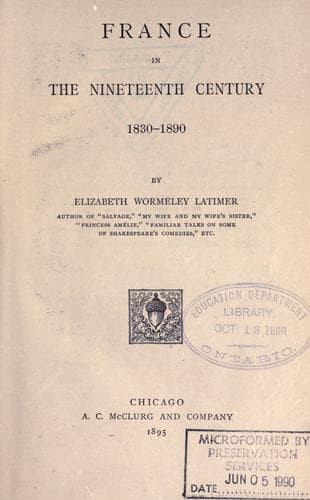
France in the Nineteenth CenturyLatimer, Elizabeth Wormeley
History
France in the Nineteenth Century
Latimer, Elizabeth Wormeley
France -- History -- 1789-1900
"I may add that I saw but one _bonnet rouge_, which I had supposed
would be the revolutionary headdress. It was worn by an ill-looking
ruffian, who sat with his back to the Quai, his legs straddled
across the foot-walk, his drunken head fallen forward on his naked,
hairy breast, a broken pipe between his knees, his doubled fists
upon the stones at either side of him."
In the story of Louis Napoleon's abortive attempt at Boulogne to
incite France against Louis Philippe's Government, we were much
indebted to the narrative of Count Joseph Orsi, one of the Italians
who from his earliest days had attended on his fortunes. The same
gentleman has given us an account of his own experiences during
the days of the Commune:--
"One could not help being struck by the contrasts presented at
that time in Paris itself: destruction and death raging in some
quarters, cannon levelling its beautiful environs, while at the
same moment one could see its fashionable Boulevards crowded with
well-dressed people loitering and smiling as if nothing were going
on. The cafés, indeed, were ordered to close their doors at midnight,
but behind closed shutters went on gambling, drinking, and debauchery.
After spending a riotous night, fast men and women considered it
a joke to drive out to the Arch of Triumph and see how the fight
was going on."
The troops at Versailles, reinforced by the prisoners of war who
had been returned from Prussia, began, by the 9th of April, to
make active assaults on such forts as were held by the Federals.
Confusion and despair began to reign in the Council of the Commune.
Unsuccessful in open warfare, the managing committee tried to check
the advance of the Versaillais by deeds of violence and retaliation.
They arrested numerous hostages, and the same night the palace of
the archbishop was pillaged. The prefect of police, Raoul Rigault,
issued a decree that every one suspected of being a _réactionnaire_
(that is, a partisan of the National Assembly) should be at once
arrested. The delivery of letters was suspended, gas was cut off,
and with the exception of a few places where lamp-posts were supplied
with petroleum, Paris was in darkness.
The Commune also issued a decree that while all men under sixty
must enter its army, women, children, and aged men could obtain
passes to leave the city at the prefecture of police for two francs
a head. The prefecture was besieged by persons striving to get
these passes, many of whom camped out for forty-eight hours while
waiting their turn.
Public-domain text, read in full here on John Shaqi.
Reviews
Reviews
No reviews yet
Be the first to share your thoughts on this work.
Elsewhere in the archive
Join the Discussion
Join the discussion
Sign in to leave a comment or review.
Sign InorCreate an account