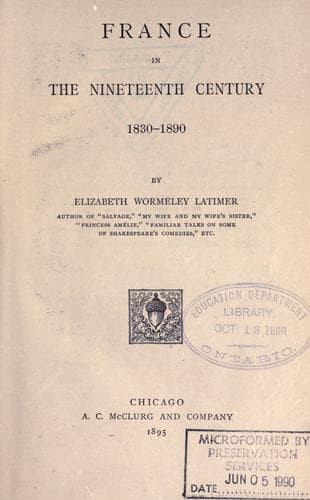
France in the Nineteenth CenturyLatimer, Elizabeth Wormeley
History
France in the Nineteenth Century
Latimer, Elizabeth Wormeley
France -- History -- 1789-1900
In the midst of this confused pressure on the prefect of police,
Count Orsi took the resolution of visiting him. As a known adherent
of the former dynasty and a personal friend of the late emperor, he
did not feel himself safe. He therefore took the bull by the horns,
and went to call on the terrible Raoul Rigault in his stronghold.
He did not see him, however; but after struggling for three hours
in the crowd of poor creatures who were waiting to pay their two
francs and receive a passport, he was admitted to the presence of
his secretary, Ferré. Ferré was writing as his visitor was shown
in, and, waving his pen, made him stand where he could see him.
When he learned his name, he said--
"Your opinions are well known to us. We also know that you have
taken no active part against us. We fight for what we believe to
be just and fair. We do not kill for the pleasure of killing, but
we must attain our end, and we _shall_, at any cost. I recommend
you to keep quiet. As you are an Italian, you shall not be molested.
However, I must tell you that you have taken a very bold step in
calling on me in this place. Your visit might have taken a different
turn. You may go. Your frank declaration has saved you."
On Easter Sunday, as the English lady to whom allusion has been
made, was leaving Paris, the population in the neighborhood of
the Place de Grève was amusing itself by a public burning of the
guillotine. It was brought forth and placed beneath a statue of
Voltaire, where it was consumed amid wild shouts of enthusiasm.
The Freemasons and trades unions sent deputies to Versailles to
endeavor to negotiate between the contending parties. M. Thiers
promised amnesty to all Communists who should lay down their arms,
except to those concerned in the deaths of Generals Lecomte and
Thomas, and he was also willing to give pay to National Guards
till trade and order should be restored; but no persuasions would
induce him to confer on Paris municipal rights that were not given
to other cities. On the 12th of May the Commune issued the following
decree:--
"_Whereas_, the imperial column in the Place Vendôme is a monument
of barbarism, a symbol of brute force and of false glory, an
encouragement to the military spirit, a denial of international
rights, a permanent insult offered to the conquered by the conquerors,
a perpetual conspiracy against one of the great principles of the
French Republic,--namely, Fraternity,--the Commune decrees thus:
The column of the Place Vendôme shall be destroyed."
Public-domain text, read in full here on John Shaqi.
Reviews
Reviews
No reviews yet
Be the first to share your thoughts on this work.
Elsewhere in the archive
Join the Discussion
Join the discussion
Sign in to leave a comment or review.
Sign InorCreate an account