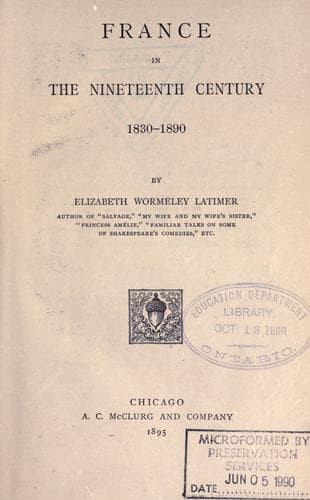
France in the Nineteenth CenturyLatimer, Elizabeth Wormeley
History
France in the Nineteenth Century
Latimer, Elizabeth Wormeley
France -- History -- 1789-1900
Thiers' grandfather, the cloth merchant, was a Royalist, who brought
down upon himself the wrath of the Jacobins by inciting the more
moderate party in Marseilles to seize the commissioners sent to
them by the Convention, and imprison them in the Château d'If. His
son (Thiers' father), being himself a Jacobin, helped to release
the prisoners, and accepted an office under them in Marseilles. This
was the reason why he had to conceal himself during the reaction
that followed the fall of Robespierre. But all his life he bobbed
like a cork to the surface of events, or with equal facility sank
beneath them. He seems to have been "everything by turns, and nothing
long." Among other employments he became an _impressario_, and
went with an opera _troupe_ to Italy. There for a time he kept a
gaming table, and finally turned up at Joseph Bonaparte's court
at Naples. He became popular with King Joseph, and followed him to
Madrid. He was a French Micawber, without the domestic affections
of his English counterpart, but with far more brilliant chances.
His wife was left to struggle at Marseilles with her own boy to
support, and with a host of step-children. What she would have
done but for the kindness of her mother, Madame Arnic, it is hard
to tell.
Meantime Adolphe was adopted and educated by Madame Arnic. She
had provided him from his birth with influential patrons in the
persons of two well-to-do godfathers. The boy was brought up in
one of those beautiful _bastides_, or sea-and-country villas, which
adorn the shores of Provence. There he ran wild with the little
peasant boys, and subsequently in Marseilles with the _gamins_
of the city.
His cousin, the poet André Chénier, got him an appointment to one
of the _lycées_, or high-schools, established by Napoleon; but his
grandmother would not hear of his "wearing Bonaparte's livery."
The two god-fathers had to threaten to apply to the absent Micawber
on the subject, if the boy's mother and grandmother stood in the way
of his education. They yielded at last, and accepted the appointment
offered them. Adolphe passed with high marks into the institution,
and it cost him no trouble to keep always at the head of his classes.
But in play hours there was never a more troublesome boy. He so
perplexed and annoyed his superiors that they were on the eve of
expelling him, when a new master came to the _lycée_ from Paris, and
all was changed. This master had ruined his prospects by writing a
pamphlet against the Empire. A warm friendship sprang up between him
and his brilliant pupil. The good man was an unbending republican.
When Thiers became Prime Minister of France under Louis Philippe,
he wrote to his old master and offered him an important post in
the Bureau of Public Instruction; but the old man refused it. He
would not accept Louis Philippe as "the best of republics," and
ended his letter by saying: "The best thing I can wish you is that
you may soon retire from office, and that for a long time."
Public-domain text, read in full here on John Shaqi.
Reviews
Reviews
No reviews yet
Be the first to share your thoughts on this work.
Elsewhere in the archive
Join the Discussion
Join the discussion
Sign in to leave a comment or review.
Sign InorCreate an account