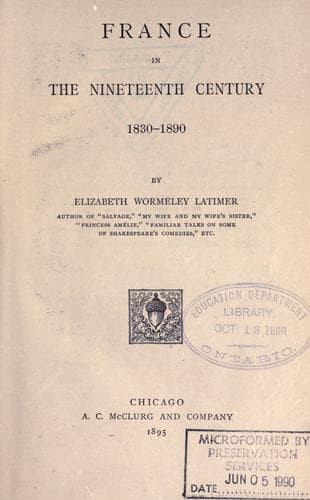
France in the Nineteenth CenturyLatimer, Elizabeth Wormeley
History
France in the Nineteenth Century
Latimer, Elizabeth Wormeley
France -- History -- 1789-1900
The influence of this new teacher roused all Thiers' faculties
and stimulated his industry. From that time forward he became the
most industrious man of his age. The bulletins and the victories
of Napoleon excited his imagination. He would take a bulletin for
his theme, and write up an account of a battle, supplementing his
few facts by his own vivid imagination. His idea was that France
must be the strongest of European powers, or she would prove the
weakest; she could not hold a middle place in the federation of
European nations.
When Thiers had finished his school course his grandmother mortgaged
her house to supply funds for his entrance into the college at
Aix. He could not enter the army on account of his size, and he
aspired to the Bar. His family was very poor at that period. Thiers
largely supported himself by painting miniatures, which it is said
he did remarkably well.
At Aix he found good literary society and congenial associations.
His friendship with his fellow-historian, Mignet, began in their
college days. At Aix, too, where he was given full liberty to enjoy
the Marquis d'Alberta's gallery of art and wonderful collection
of curiosities and bronzes, he acquired his life-long taste for
such things. Aix was indeed a place full of collections,--of
antiquities, of cameos, of marbles, etc.
Thiers' first literary success was the winning a prize at Nîmes for
a monograph on Vauvenargues, a moralist of the eighteenth century,
called by Voltaire the master-mind of his period. He won this prize
under remarkable circumstances. The commission to award it was
composed, largely of Royalists, who did not like to assign it to a
competitor, who, if not a Republican, was at least a Bonapartist.
Thiers had read passages from his essay to friends, and the
commissioners were aware of its authorship. They therefore postponed
their decision. Meantime Thiers wrote another essay on the same
subject. Mignet had it copied, and forwarded to Nîmes from Paris,
with a new motto. This essay won the first prize; and Thiers' other
essay won the second prize, greatly to his amusement and delight,
and to the annoyance and discomfiture of the Committee of Decision.
With six hundred francs in his pocket ($120), he went up to Paris,
making the journey on foot. Having arrived there, he made his way
to his friend Mignet's garret, weary and footsore, carrying his
bundle in his hand. Mignet was not at home; but in the opposite
chamber, which Thiers entered to make inquiries for his friend, was
a gay circle of Bohemians, who were enjoying a revel. The traveller
who broke in upon their mirth is thus described:--
"He wore a coat that had been green, and was faded to yellow, tight
buff trousers too short to cover his ankles, and dusty, and glossy
from long use, a pair of clumsy blucher boots, and a hat worthy
of a place in the cabinet of an antiquary. His face was tanned
a deep brown, and a pair of brass-rimmed spectacles covered half
his face."
Public-domain text, read in full here on John Shaqi.
Reviews
Reviews
No reviews yet
Be the first to share your thoughts on this work.
Elsewhere in the archive
Join the Discussion
Join the discussion
Sign in to leave a comment or review.
Sign InorCreate an account