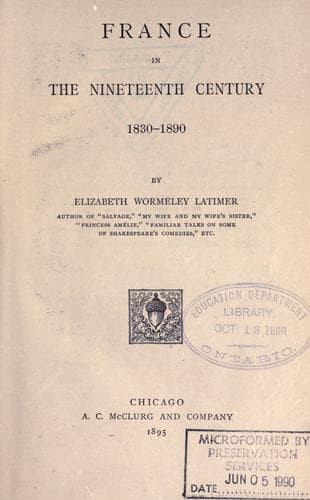
France in the Nineteenth CenturyLatimer, Elizabeth Wormeley
History
France in the Nineteenth Century
Latimer, Elizabeth Wormeley
France -- History -- 1789-1900
In 1869 there was a general election in France, which was carefully
manipulated by the Government, in order that, if possible, no deputy
might be sent to the Chamber who would provoke discussion on the
changes in the Constitution submitted by the emperor. Thiers thought
it time for him to re-enter public life and to speak out to his
countrymen. At this time one of the gentlemen attached to the English
embassy in Paris had a conversation with him. "For a man," he says,
"of talents, learning, and experience, I never met one who impressed
me as having so great an idea of his own self-importance;" but
the visitor was at the same time impressed by his frankness and
sincerity. Speaking of the Emperor Napoleon III., and foreseeing
his downfall, he said: "What will succeed him, I know not. God
grant it may not be the ruin of France!... For a long time I kept
quiet. It was no use breaking one's head against the wall; but
now we have revolution staring us in the face as an alternative
with the Empire; and do you think I should be doing well or rightly
by my fellow-citizens, were I to keep in the background? If I am
wanted, I shall not fail." As he spoke, the fire in his eyes sparkled
right through the glass of his spectacles, and all the time he
talked, he was walking rapidly up and down. When greatly animated,
he seemed even to grow taller and taller, so that on some great
occasion a lady said of him to Charles Greville: "Did you know,
Thiers is handsome! and is six feet high!"
When the fall of the Empire occurred, in September, 1870, M. Thiers
was in Paris; but when the Committee of Defence was formed, he
quitted the capital, before the arrival of the Prussians, to go
from court to court,--to London, St. Petersburg, Vienna,--to implore
the intervention of diplomacy, and to prove how essential to the
balance of power in Europe was the preservation of France. His
feeling was that France ought promptly to have made peace after
Sedan, that her cause then was hopeless for the moment, and that by
making the best terms she could, and by husbanding her resources,
she might rise in her might at a future day. These views were not
in the least shared by Gambetta, who believed--as, indeed, most
Frenchmen and most foreigners believed in 1870--that a general
uprising in France would be sufficient to crush the Prussians.
Thiers knew better; his policy was to save France for herself and
from herself at the same time.
[Illustration: _LÉON GAMBETTA._]
Public-domain text, read in full here on John Shaqi.
Reviews
Reviews
No reviews yet
Be the first to share your thoughts on this work.
Elsewhere in the archive
Join the Discussion
Join the discussion
Sign in to leave a comment or review.
Sign InorCreate an account