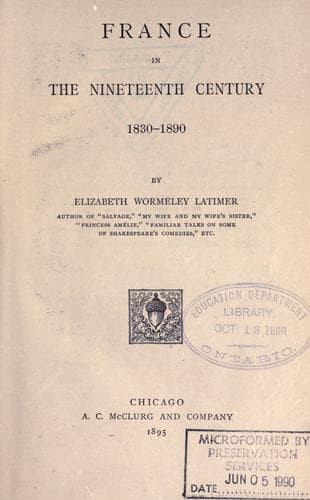
France in the Nineteenth CenturyLatimer, Elizabeth Wormeley
History
France in the Nineteenth Century
Latimer, Elizabeth Wormeley
France -- History -- 1789-1900
We already know the story. Gambetta escaped from Paris in a balloon,
and joined Crémieux and Garnier-Pagès, the other two members of
the Committee of Defence who were outside of Paris. At Tours they
had set up a sort of government, and there, in virtue of being
the War Minister of the Committee of Defence, Gambetta proceeded
to take all power into his own hands, and to become dictator of
masterless France. It was like a shipwreck in which, captain and
officers being disabled, the command falls to the most able seaman.
Gambetta had no legal right to govern France, but he governed it
by right divine, as the only man who could govern it.
This is how a newspaper writer speaks--and justly--of Gambetta's
government:--
"From the moment when he dropped, tired out with his journey by
balloon, into his chair in the archiepiscopal palace at Tours,
and announced that he was invested with full powers to defend the
country, no one throughout France seriously disputed his authority.
His colleagues became his clerks. The treasury was empty, but he
re-filled it. The arsenal was half empty, but in six weeks one
great army, and almost two, were supplied with artillery, horses,
gunners, and breech-loaders. The Lyons Reds had been told that
they were wicked fools, and Communists and Anarchists ripe for
revolt in Toulouse, Lyons, and Marseilles had been put down. The
respectables everywhere rose at his summons, anarchy and military
disobedience quailed."
The fortunes of war forced Gambetta and his Government from the
banks of the Loire to Bordeaux. There, at the close of January,
1871, Jules Favre arrived from the Central Committee in Paris to
announce, with shame and grief, that resistance was over: Paris
had capitulated to the Prussians; and it only remained to elect a
General Assembly which should create a regular government empowered
to make peace with the enemy.
For a few hours that night the fate of France hung trembling in
the scales. Thiers was in Bordeaux. He was known to think that
France could only save what was left by accepting the armistice.
Gambetta was known to be for _No Surrender!_ Which should prevail?
Would the dictator lay aside his power without a struggle?
Gambetta rose to the occasion during the night; but here the histories
of Thiers and Gambetta run together; therefore, before I tell of what
happened the next day, let me say a few words about the personal
history of Léon Gambetta. He was only thirty-three years old at
this time, having been born in 1838, when Thiers was forty-one
years of age.
Public-domain text, read in full here on John Shaqi.
Reviews
Reviews
No reviews yet
Be the first to share your thoughts on this work.
Elsewhere in the archive
Join the Discussion
Join the discussion
Sign in to leave a comment or review.
Sign InorCreate an account