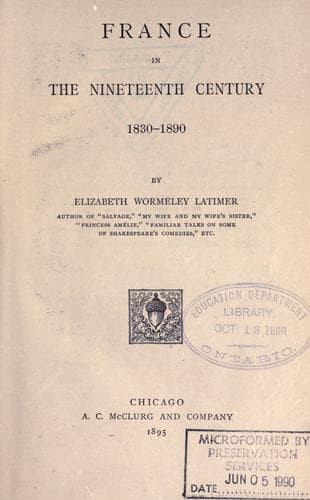
France in the Nineteenth CenturyLatimer, Elizabeth Wormeley
History
France in the Nineteenth Century
Latimer, Elizabeth Wormeley
France -- History -- 1789-1900
Gambetta's birthplace was Cahors, that city in the South of France
stigmatized by Dante as the abode of usurers and scoundrels. His
family was Italian and came from Genoa, but he was born a Frenchman,
though his Italian origin, temperament, and complexion were constantly
cast up against him. In his infancy he had been intended for the
priesthood, and was sent, when seven years old, to some place where
he was to be educated and trained for it. He soon wrote to his
father that he was so miserable that if he were not taken away
he would put out one of his eyes, which would disqualify him for
the priestly calling. His father took no notice of the childish
threat, and Gambetta actually plucked out one of his own eyes.
In 1868 he was a young lawyer in Paris; but his eloquence and ability
were known only at the Café Procope to a circle of admiring
fellow-Bohemians. On All Saints Day, 1868, the Press, presuming
on the recent relaxation of personal government by the emperor,
applauded the crowds who went to cover with funeral wreaths the grave
of Baudin at Père la Chaise. Baudin had been the first man killed on
Dec. 2, 1851, when offering resistance to the _coup d'état._ The
Press was prosecuted for its utterances on this occasion. Gambetta
defended one of the journals. Being an advocate, he could say what
he pleased without danger of prosecution, and all Paris rang with
the bitterness of his attack upon the Empire. From that moment he
was a power in France. In person he was dark, short, stout, and
somewhat vulgar, nor was there any social polish in his manners.
Not long after his great speech in defence of the Press, in the matter
of Baudin, Gambetta was elected to the Chamber by the working-men
of Belleville, and at the same time by Marseilles. He entered the
Chamber as one wholly irreconcilable with the Empire or the emperor.
His eloquence was heart-stirring, and commanded attention even
from his adversaries.
When, on Sept. 4, 1870, the downfall of the Empire was proclaimed,
Gambetta was made a member of the Council of Defence, and became
Minister of the Interior. He remained in Paris until after the
siege had begun; but he burned to be where he could _act_, and
obtained the consent of his colleagues to go forth by balloon and
try to stir up a warlike spirit in the Provinces. He was made Minister
of War in addition to being Minister of the Interior. From Nov.
1, 1870, to Jan. 30, 1871, his efforts were almost superhuman;
and but for Bazaine's surrender at Metz, they might have been
successful.
Gambetta raised two armies,--one under General Aurelles des Paladines
and General Chanzy; the other under Bourbaki and Garibaldi. The
first was the Army of the Loire, the second of the Jura.
Public-domain text, read in full here on John Shaqi.
Reviews
Reviews
No reviews yet
Be the first to share your thoughts on this work.
Elsewhere in the archive
Join the Discussion
Join the discussion
Sign in to leave a comment or review.
Sign InorCreate an account