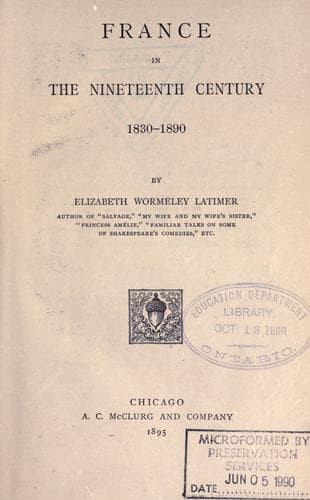
France in the Nineteenth CenturyLatimer, Elizabeth Wormeley
History
France in the Nineteenth Century
Latimer, Elizabeth Wormeley
France -- History -- 1789-1900
"With effrontery, with a miserable kind of pride, and with smiles
of triumph on his lips, he alluded to his victims with theatrical
gesticulations, and plumed himself on the magnitude of his own
infamy, answering his judges by ignoble buffooneries, playing the
part of an orator, making pretensions to learning, looking round
to see what effect he was producing, and courting applause. And
some of those who sat in judgment on him _did_ applaud. At each
of his atrocious vulgarisms many of the Peers laughed, and this
laugh naturally encouraged him. Did he make a movement to rise,
voices called out: 'Fieschi desires to say something, Monsieur le
Président! Fieschi is about to speak!' The audience was unwilling
to lose a word that might fall from the lips of so celebrated a
scoundrel. He could hardly contain himself for pride and satisfaction.
His bloody hand was eager to shake hands with the public, and there
were those willing to submit to it. He exchanged signs with the
woman Nina who was seated in the audience. He posed before the
spectators with infinite satisfaction. What more can we say? He
directed the proceedings. He prompted or browbeat the witnesses,
he undertook the duties of a prosecuting attorney. He regulated the
trial.... He directed coarse jokes at the unhappy Pepin; but reckless
as he was, he dared not meddle with Morey. He had no hesitation in
accusing himself. He owned himself the worst of criminals, and
declared that he esteemed himself happy to be able to pay with
his own blood for the blood of the unhappy victims of his crime.
But the more he talked about his coming fate, the plainer it was
that he expected pardon, and the more he flattered those on whom
that pardon might depend."
The trial lasted twelve days, and very little was elicited about
the conspiracy,--if indeed there was one. Suddenly Pepin, whose
terror had been abject, rallied his courage, refused to implicate
Morey or to make revelations, and kept his resolution to the last.
One of the five prisoners was acquitted, one was condemned to a
brief imprisonment, and Morey, Pepin, and Fieschi were sent to
the block. Up to almost the last moment Fieschi expected pardon;
but his last words were to his confessor: "I wish I could let you
know about myself five minutes from now."
On the scaffold Morey's white hair elicited compassion from the
spectators. Pepin at the last moment was offered a pardon if he
would tell whence the money came that he had advanced to Fieschi.
He refused firmly, and firmly met his fate.
The next day the woman who had betrayed her lover and the rest was
presiding at a café on the Place de la Bourse, having been engaged
as an attraction!
After these horrors we turn with relief to some account of good
and noble women, the ladies of Louis Philippe's family.
Public-domain text, read in full here on John Shaqi.
Reviews
Reviews
No reviews yet
Be the first to share your thoughts on this work.
Join the Discussion
Join the discussion
Sign in to leave a comment or review.
Sign InorCreate an account