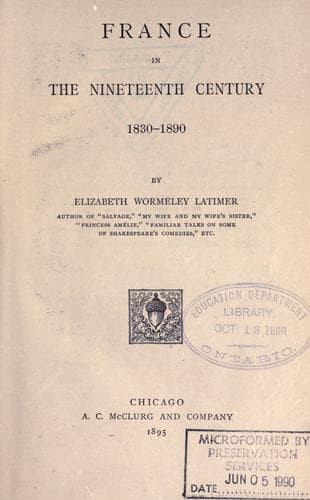
France in the Nineteenth CenturyLatimer, Elizabeth Wormeley
History
France in the Nineteenth Century
Latimer, Elizabeth Wormeley
France -- History -- 1789-1900
Marie Amélie used sometimes to tell her children how she had wept
when a child for the death of the little dauphin, the eldest son
of Louis XVI., who, before the Revolution broke out, was taken
away from the evil to come. She was to have been married to him
had he lived. When older, she had an early love-affair with her
cousin, Prince Antoine of Austria; but he was destined for the
Church, and the youthful courtship came to an untimely end. When
she first met her future husband, she and her family were living in
a sort of provisional exile in Palermo. The princess was twenty-seven,
Louis Philippe was ten or twelve years older, and they seem to have
been quite determined to marry each other very soon after their
acquaintance began. It was not easy to do so, however, for the
duke, as we have seen, was at that period too much a republican
to suit even an English Admiral; but the princess declared that
she would go into a convent if the marriage was forbidden, and
on Dec. 25, 1809, she became the wife of Louis Philippe.
No description could do justice to the purity and charity of this
admirable woman; and in her good works she was seconded by her
sister-in-law, Madame Adélaïde, and by her daughter.
"The queen," her almoner tells us, "had 500,000 francs a year for
her personal expenses, and gave away 400,000 of them." "M. Appert,"
she would say to him, "give those 500 francs we spoke of, but put
them down upon next month's account. The waters run low this month;
my purse is empty." An American lady, visiting the establishment
of a great dressmaker in Paris, observed an old black silk dress
hanging over a chair. She remarked with some surprise: "I did not
know you would turn and fix up old dresses." "I do so only for
the queen," was the answer.
The imposture, ingratitude, and even insolence of some of Marie
Amélie's petitioners failed to discourage her benevolence. For
instance, an old Bonapartist lady, according to M. Appert, one day
wrote to her:--
MADAME,--If the Bourbons had not returned to France, for the
misfortune of the country, my beloved mistress and protectress,
the Empress Marie Louise, would still be on the throne, and
I should not be under the humiliating necessity of telling you
that I am without bread, and that the wretched bed on which I
sleep is about to be thrown out of the garret I inhabit, because
I cannot pay a year's rent. I dare not ask you for assistance,
for my heart is with my real sovereign, and I cannot promise
you my gratitude. If, however, you think fit to preserve a life
which, since the misfortunes of my country, has been full of
bitterness, I will accept a loan. I should blush to receive a
gift.
I am, Madame, your servant, C.
Public-domain text, read in full here on John Shaqi.
Reviews
Reviews
No reviews yet
Be the first to share your thoughts on this work.
Join the Discussion
Join the discussion
Sign in to leave a comment or review.
Sign InorCreate an account