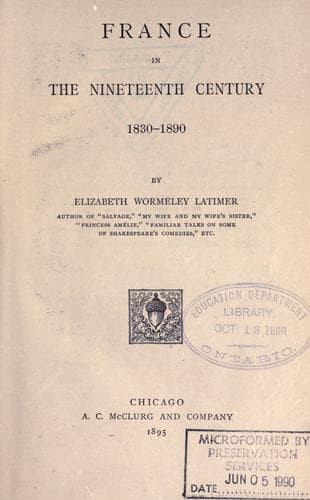
France in the Nineteenth CenturyLatimer, Elizabeth Wormeley
History
France in the Nineteenth Century
Latimer, Elizabeth Wormeley
France -- History -- 1789-1900
Louis Bonaparte was nine years younger than his brother Napoleon,
who by no right of primogeniture, but by right of success, was
early looked upon as the head of the family of Bonaparte. He assumed
the place of father to his little brother Louis, and a very
unsatisfactory father he proved. Louis was studious, poetical,
solid, honorable, and unambitious. His brother was resolved to
make him a distinguished general and an able king. He succeeded
in making him a brave soldier and a very good general; but Louis
had no enthusiasm for the profession of arms. He hated bloodshed,
and above all he hated sack and pillage. He had no genius, and
crooked ways of any kind were abhorrent to him. When a very young
man he fell passionately in love with a lady, whom he called his
Sophie. But his brother and the world thought the real name of
the object of his affection was Emilie de Beauharnais, the Empress
Josephine's niece by marriage. This lady became afterwards the wife
of M. de La Vallette, Napoleon's postmaster-general, who after
the return of the Bourbons in 1815, was condemned to death with
Ney and Labédoyère. His wife saved him by changing clothes with
him in prison; but the fearful strain her nerves suffered until
she was sure of his escape, unsettled her reason. She was not sent
to an asylum, but lived to a great age in an _appartement_ in Paris,
carefully tended and watched over by her friends.[1]
[Footnote 1: Jerrold's Life of Napoleon III.]
But whether it was with a Sophie or an Emilie, Louis Bonaparte fell
in love, and Hortense de Beauharnais, the daughter of Josephine, gay,
lively, poetical, and enthusiastic, had given her heart to General
Duroc, the Emperor Napoleon's aide-de-camp; therefore both the young
people resisted the darling project of Napoleon and Josephine to
marry them to each other. By such a marriage Josephine hoped to
avert the divorce that she saw to be impending. She fancied that
if sons were born to the young couple, Napoleon would be content
to leave his throne to the heir of his brother Louis, whom he had
adopted, and of his step-daughter, of whom he was very fond. But
Louis would not marry Hortense, and Hortense would not have Louis.
At last, however, in the excitement of a ball, a reluctant consent
was wrung from Louis; then Hortense was coerced into being a good
French girl, and giving up Duroc. She and Louis were married. A more
unhappy marriage never took place. Husband and wife were separated
by an insurmountable (or at least unsurmounted) incompatibility of
temperament. Louis was a man whose first thought was duty. Hortense
loved only gayety and pleasure. He particularly objected to her
dancing; she was one of the most graceful dancers ever seen, and
would not give it up to please him. In short, she was all graceful,
captivating frivolity; he, rigid and exacting. Both had burning
memories in their hearts of what "might have been," and above all,
after Louis became king of Holland, each took opposite political
views.
Public-domain text, read in full here on John Shaqi.
Reviews
Reviews
No reviews yet
Be the first to share your thoughts on this work.
Join the Discussion
Join the discussion
Sign in to leave a comment or review.
Sign InorCreate an account