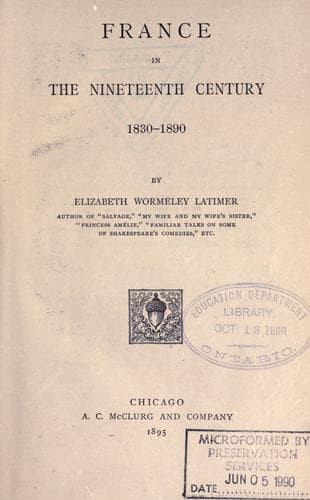
France in the Nineteenth CenturyLatimer, Elizabeth Wormeley
History
France in the Nineteenth Century
Latimer, Elizabeth Wormeley
France -- History -- 1789-1900
"One day, when she wished to know as usual, what we would like
best, my brother, who was three years older than I, and consequently
more full of sentiment, asked for a watch, with a portrait of our
mother; but I, when the empress said: 'Louis, ask for whatever
will give you the greatest pleasure,' begged to be allowed to go
out and paddle in the gutter with the little boys in the street.
Indeed, until I was seven years old it was a great grief to me to
have to ride always in a carriage with four or six horses. When,
in 1815, just before the arrival of the allied army in Paris, we
were hurried by our tutor to a hiding-place, and passed on foot
along the Boulevards, I felt the keenest sensations of happiness
within my recollection. Like all children, though perhaps even
more than most children, soldiers fixed my attention. Whenever at
Malmaison I could escape from the _salon_, I was off to the great
gates, where there were always grenadiers of the Garde Impériale.
One day, from a ground-floor window I entered into conversation
with one of these old _grognards_ who was on duty. He answered me
laughing. I called out: 'I know my drill. I have a little musket!'
Then the grenadier asked me to put him through his drill, and thus
we were found, I shouting, 'Present arms! Carry arms! Attention!'
the old grenadier obeying, to please me. Imagine my happiness! I
often went with my brother to breakfast with the emperor. When
he entered the room, he would come up to us, take our heads in
his hands, and so lift us on the table. This frightened my mother
very much, Dr. Corvisart having told her that such treatment was
very bad for children."
The day before the Emperor Napoleon left Paris for the campaign
of Waterloo, Hortense carried her boys to the Tuileries to take
leave of him. Little Louis Napoleon contrived to run alone to his
uncle's cabinet, where he was closeted with Marshal Soult. As soon
as the boy saw the emotion in the emperor's face, he ran up to
him, and burying his head in his lap, sobbed out: "Our governess
says you are going to the wars,--don't go; don't go, Uncle." "And
why not, Louis? I shall soon come back." "Oh, Uncle, those wicked
allies will kill you! Let me go with you." The emperor took the
boy upon his knee and kissed him. Then, turning to Soult, who was
moved by the little scene, he said, "Here, Marshal, kiss him; he
will have a tender heart and a lofty spirit; he is perhaps the
hope of my race."
After Waterloo, the emperor, who passed one night in Paris, kissed
the children at the last moment, with his foot upon the step of
the carriage that was to carry him the first stage of his journey
to St. Helena.
Public-domain text, read in full here on John Shaqi.
Reviews
Reviews
No reviews yet
Be the first to share your thoughts on this work.
Join the Discussion
Join the discussion
Sign in to leave a comment or review.
Sign InorCreate an account