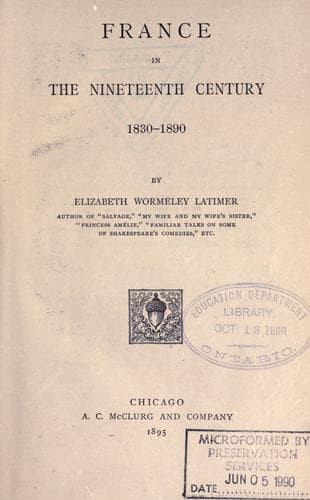
France in the Nineteenth CenturyLatimer, Elizabeth Wormeley
History
France in the Nineteenth Century
Latimer, Elizabeth Wormeley
France -- History -- 1789-1900
King Louis and Queen Hortense were exceedingly distressed; both
foresaw the hopelessness of the Italian rising. Queen Hortense went
at once to Florence to consult her husband, and it was arranged that
she should go in pursuit of her sons, inducing them, if possible,
to give up all connection with so hopeless a cause. But before she
reached them, the insurgents, who seem to have had no fixed plan
and no competent leader, had come to the conclusion that Bonapartes
were not wanted in a struggle for republicanism; they therefore
requested the young men to withdraw, and their mother went after
them to Ancona. On her way she was met by her son Louis, who was
coming to tell her that his brother was dead. There has always been
mystery concerning the death of this young Napoleon. The accredited
account is that he sickened with the measles, and died at a roadside
inn on his way to Ancona. The unhappy mother went into that little
town upon the Adriatic with her youngest son; but she soon found
that the Austrians, having come to the help of the Pope, were at
its gates. Louis, too, had sickened with the measles. She hid him
in an inner chamber, and spread a report that he had escaped to
Corfu. She had with her an English passport for an English lady,
travelling to England with her two sons. She was obliged to substitute
a young Italian, who was compromised, for her dead son; and as
soon as Louis could rise from his bed, they set out, meeting With
many adventures until they got beyond the boundaries of Italy.
Under cover of their English passport they crossed France, and
visited the Château of Fontainebleau, where the mother pointed out
to her son the scenes of his childhood.
The death of the Duc de Reichstadt in July, 1832, caused Louis
Napoleon to consider himself the head of the Napoleonic family.
According to M. Claude, the French Minister of Police, he came on
this occasion into Paris, and remained there long enough to dabble
in conspiracy.
After spending a few months in England, mother and son went back
to Arenenberg, where they kept up a close correspondence with all
malcontents in France. The Legitimists preferred them the house of
Orleans, and the republicans of that period--judging from their
writings as well as their acts--evidently believed that Louis Napoleon,
now head of the house of Bonaparte, represented republican principles
based on universal suffrage, as well as the glories of France.
Public-domain text, read in full here on John Shaqi.
Reviews
Reviews
No reviews yet
Be the first to share your thoughts on this work.
Join the Discussion
Join the discussion
Sign in to leave a comment or review.
Sign InorCreate an account